







Knowledge Base
How to Secure Loads on a Flatbed Trailer? Use These Vital Tips!
Every year in the United States, about 25,000 road accidents are linked to debris on the roads. Some of these accidents can be deadly. Meanwhile, in the United Kingdom, 22,000 accidents in 2015 were caused by items falling off heavy equipment trailers. These statistics show just how important it is to secure loads on your equipment properly.
When you keep a load firmly in place, you protect drivers and pedestrians from potential crashes and also avoid the extra costs that often follow such accidents.

Why Secure Loads?
Securing a load can feel like a challenge. Sometimes, no matter how prepared you are, things can still go wrong. For instance, if the cargo shifts while on a flatbed trailer, both people and cargo can fall, forcing you to pull over and secure the load again—a process that can be time-consuming and tiring.
Unsecured loads can also cause vehicles to overturn or roll. A load may shift forward if there is a gap between the cargo and the headboard. This puts the driver and other road users at risk. The goods being shipped might break or spill onto the road.
What You Must Do to Secure Load
When you need to secure heavy loads on equipment hauling vehicles, there are two main factors to remember:
- Loads must be restrained. In other words, the load must be firmly tied down so it cannot fall off.
- Loads must be contained. The load must be held in such a way that it cannot move sideways or shift forward.
To accomplish these goals, you should take several steps:
1. Get into the Finer Details of Securing a Load
A skilled trucker must consider four things when actually securing a load on heavy haul vehicles:
- Tying it down
- Covering it up
- Loading light
- Loading it right
A range of equipment can be used to restrain or tie down a load, such as ropes, nets, chains, straps, and webbing. The choice of tool depends on the type of load and the vehicle involved.
Typical types of cargo include rolls, drums, cylindrical loads, boxes, sacks, metal items, bales, loose bricks, and mixed bricks. Each type should be tied down so it stays in place and does not get damaged during transport.
- Cylindrical loads (e.g., pipes or drums) often need nets and webbing to prevent rolling.
- Sacks and boxes should be stacked to a safe height to avoid shifting.

Get Quotations!
Contact us2. Heavier Goes Lower
It is crucial to place heavier loads at the bottom of heavy equipment trailers and stack lighter items on top. This arrangement:
- Lowers the center of gravity, improving stability.
- Protects lighter loads from damage.
- Prevents the trailer from tipping if the heavy cargo is placed too high.
- Makes the loading process simpler and safer.
Avoid overloading under all circumstances. Keep the load at the level of the trailer bed, or slightly higher if it is tied down or netted securely. Choosing the right vehicle for the cargo is key to preventing overloads. If you use the wrong vehicle, no amount of tying down can fix the imbalance.
3. Tie-Down Requirements That You Must Understand
- If a vehicle has crawler wheels or tracks, you should use four tie-downs to stop unwanted movement.
- A single tie-down is a device routed through an anchor point and attached to both sides of the vehicle. However, a chain can count as two tie-downs if it is correctly attached to two different anchor points.
- A tie-down should be secured near the front and rear of the equipment. If you are unsure about the cargo’s weight, use more tie-downs to stay on the safe side.

To ensure you have done all you can to secure the load, use this checklist:
- Confirm that the vehicle’s gross weight rating is not exceeded.
- Check if you need special permits for oversize cargo.
- Know the safety guidelines for securing equipment, including how to use locking pins and deck wideners.
- Figure out the best place in the vehicle for your cargo.
- Make sure the equipment and cargo attachment points are in good condition.
- Decide if friction devices, like friction mats, should be used.
- If the equipment has rubber tires, confirm that they are at the correct pressure.
- Clean off any dirt or debris that might blow off or fall during transit.
- Only start loading when you understand how to use the gear.
- Follow manufacturer guidelines for securing loads.
- Use chains for heavy equipment and machinery.
- Preferably, use direct tie-downs for stronger load security.
- Employ wedges, cradles, or chocks to keep wheeled vehicles from rolling.
- Always check if the load is securely tied down before leaving.
Get Quotations!
Contact us4. Come Up With a Plan on Securing Load
It is wise to plan how you will secure loads effectively. This might mean setting aside enough resources for the job, such as buying proper tools and training employees. Also, assign duties according to each person’s skills.
For example, choose who will handle loading, who will handle unloading, and who will respond if a load shifts in transit. Think in advance about what to do if a vehicle arrives at a site and the cargo has already moved.
Check the condition of the shifted load, then decide quickly on how to unload it or fix it safely.
5. Check the Trailers
Vehicles that carry heavy loads must meet certain requirements:
- The front-end structure of the trailer should be high and wide enough to block cargo from moving forward. Four feet above the trailer floor is a good guideline, and the width should match that of the vehicle.
- The front-end structure should be sturdy enough that the load does not touch any part of the vehicle’s cabin.
- There should be backup devices in place if one part fails.

Get Quotations!
Contact us6. Compare the Load and the Vehicle
Even if you have a heavy haul vehicle that meets all the necessary standards, your load might still be unsuitable. For instance, if the cargo is too large or bulky to be tied down safely in the trailer, you risk an accident.
If the load sticks out too far beyond the back or sides, it could also lead to problems, such as scraping against objects or causing collisions. A typical example is firewood that often juts out too far.
In cases like these, it is better to use a different trailer or a more suitable transport option.
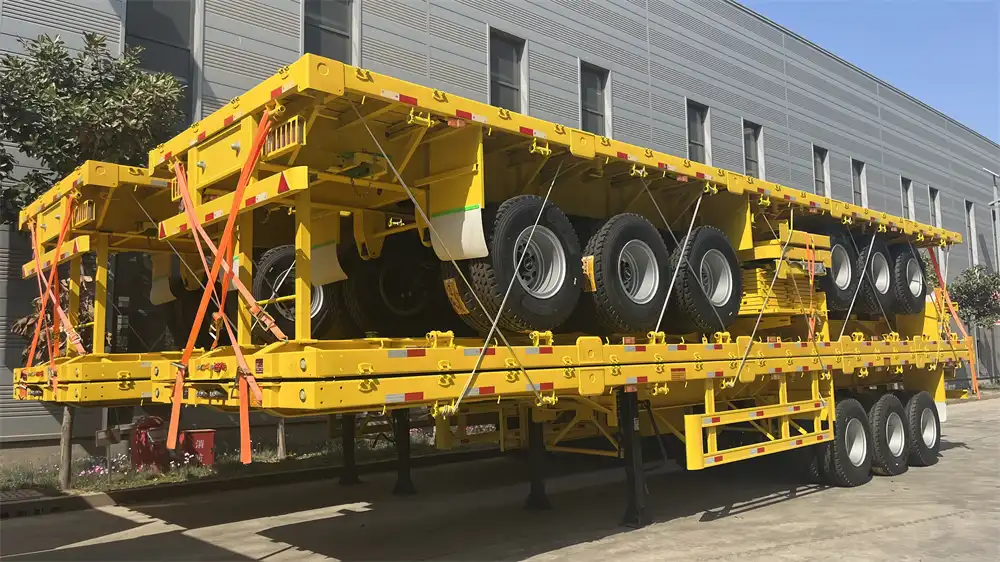
7. Get the Devices to Secure Cargo
Several devices can help you tie down a load properly, including:
- Chains
- Cables
- Fire webbing
- Steel straps
These must be of good quality and inspected by someone knowledgeable. It is also important to supply safety equipment (like gloves, hard hats, and reflective vests) for workers loading the trailers, reducing the risk of injuries.
8. Communicate
Even if you have planned how to secure loads and given out specific tasks, communication is key. Everyone involved should understand their role in loading heavy equipment trailers.
Drivers need to know the basics of loading, and they must be told that they can be held responsible if something goes wrong during handover. They also need to understand they should report to security upon arrival and remain with the trailer until unloading is complete.
Coordination is also vital with suppliers and the people at the delivery location. This helps identify any issues before unloading and prevents confusion or delays.
Get Quotations!
Contact us9. Outsourcing Versus In-House: Which Is Best When Loading Heavy Equipment Trailers?
Given the risks of failing to secure loads, you may wonder if you should use your in-house team or hire professional service providers.
- In-House: Using your own workers may cost less at first. However, if your team is not skilled, accidents can lead to expensive lawsuits or damaged goods.
- Outsourcing: Hiring qualified experts can be more expensive upfront, but your cargo is more likely to reach its destination safely and in good condition.
To get the best of both worlds, you can train your own employees. Skilled professionals can be brought in to teach them how to handle specific tasks properly and to stay updated on rules and regulations. Training can be done in person or online to cut costs.
After training, you may also want to decide if your workers should be specialized (focusing on one job) or diversified (able to handle several tasks). For example, a driver can be trained strictly to drive or can be taught to handle both driving and dealing with heavy haul issues that might arise.
10. The Final Questions to Answer
After doing everything possible to secure a heavy load, take a moment to ask:
- Would I feel safe driving behind this heavy haul vehicle?
- Would I be comfortable if this vehicle was driving near my neighborhood?
- What if I suddenly hit a bump in the road?
- Does my load make me want to drive more slowly?
- How severe would the damage be if I had an accident?
If your answers make you feel uncertain, go back and review the essentials of securing a heavy load. It is never wise to rush the process of securing loads. You might take days or even weeks to do it properly, depending on the nature of the cargo and how many people are available to help.
Get Quotations!
Contact usBottom Line
When a load falls off, it can lead to:
- Losses
Goods might be ruined in an accident, which can be very costly for both the transport company and the owner of the cargo, especially if the cargo is valuable or irreplaceable. - Injuries
Drivers and pedestrians can be harmed, sometimes severely. Drivers rely on their work for income, so they may lose wages while recovering. Pedestrians also face medical bills and lost time. - Time Wastage
An accident causes major traffic delays and holds up delivery. Drivers may also spend days dealing with insurance claims or legal matters.
Furthermore, in the United States, under the Road Traffic Act of 1991, failing to secure loads is against the law. Authorities carry out inspections to confirm that you have done your part in preventing accidents.
In the end, securing your load on heavy equipment trailers is vital. It saves money by reducing damage and legal fees, prevents injuries, and keeps you in compliance with legal regulations. Make sure you know exactly what to do when loading your vehicle—and have a plan for unexpected situations.

