







Knowledge Base
Fuel Tank Trailer Guide: Diesel, Petrol, and Oil Tanker Designs & Specifications

Ever watched a fuel tank trailer thundering down the highway and wondered what keeps 40,000 liters of gasoline from becoming a rolling disaster? You’re not alone. Whether you’re spec’ing your first diesel tanker trailer or troubleshooting why your aluminum tank trailer’s baffles keep singing, this guide breaks down everything that matters.
We’re talking about the heavy-duty fuel tanker trailers that supply gas stations, refineries, and industrial sites—not the small utility trailers you’d tow behind a pickup. These semi tank trailers haul anywhere from 30,000 to 60,000 liters of petroleum products, each one engineered to prevent the catastrophic scenarios that keep safety inspectors awake at night.
What You'll Learn
This guide covers the complete anatomy of fuel tank trailers, including:
- Tank Design & Materials: Why aluminum tank trailers dominate North American highways while carbon steel tanks rule developing markets
- Internal Components: How baffles prevent liquid surge that could flip a 40-ton rig
- Loading Systems: Bottom loading vs. top loading—and why one method kills fewer workers
- Safety Systems: Emergency shutoffs, vapor recovery valves, and the tech that prevents explosions
- Inspection Methods: From magnetic powder testing to ultrasonic scans that catch hairline cracks
- Buying Considerations: What separates a $50,000 bargain from a $50,000 lawsuit waiting to happen
- Maintenance Protocols: The inspection checklist that could save your CDL (and your life)
Who Needs This Guide
- Fleet Operatorsplanning to purchase or maintain oil tank trailers
- Engineersdesigning or modifying fuel transport systems
- Safety Managersestablishing maintenance schedules and inspection protocols
- Driverswho want to understand their equipment beyond “point and shoot”
- Procurement Teamsevaluating tanker specifications against DOT/ADR compliance requirements
Tank truck trailers aren’t just big metal cylinders on wheels. They’re precisely engineered systems where a single failed weld or stuck valve can trigger environmental disasters, massive lawsuits, or worse. Understanding their design isn’t optional—it’s survival.
Chapter 1: Fuel/Oil Tank Trailer
1.1 What is a Fuel Tank Trailer?
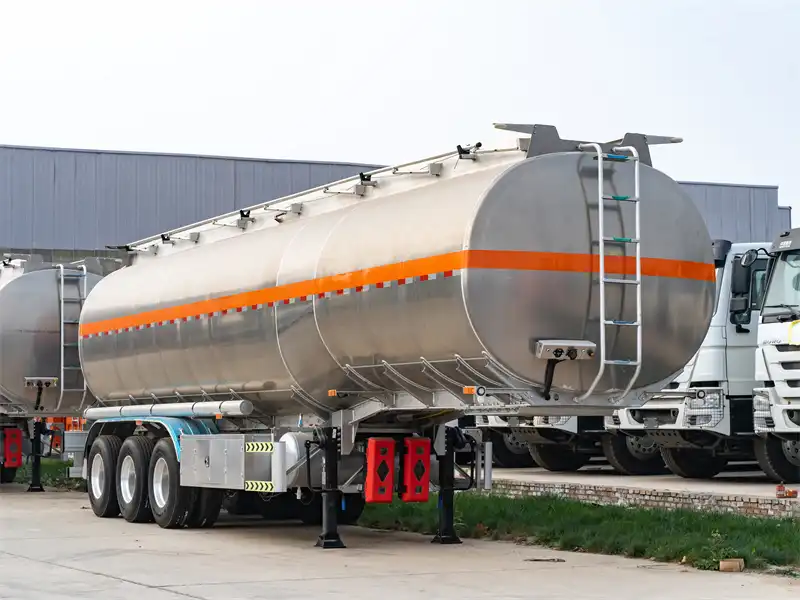
A fuel tank trailer is a specialized semi-trailer designed to transport petroleum products—gasoline, diesel, benzene, and other flammable liquids—in bulk quantities. You’ll spot these diesel tanker trailers feeding gas stations at dawn, supplying aviation fuel to airports, or hauling crude between refineries.
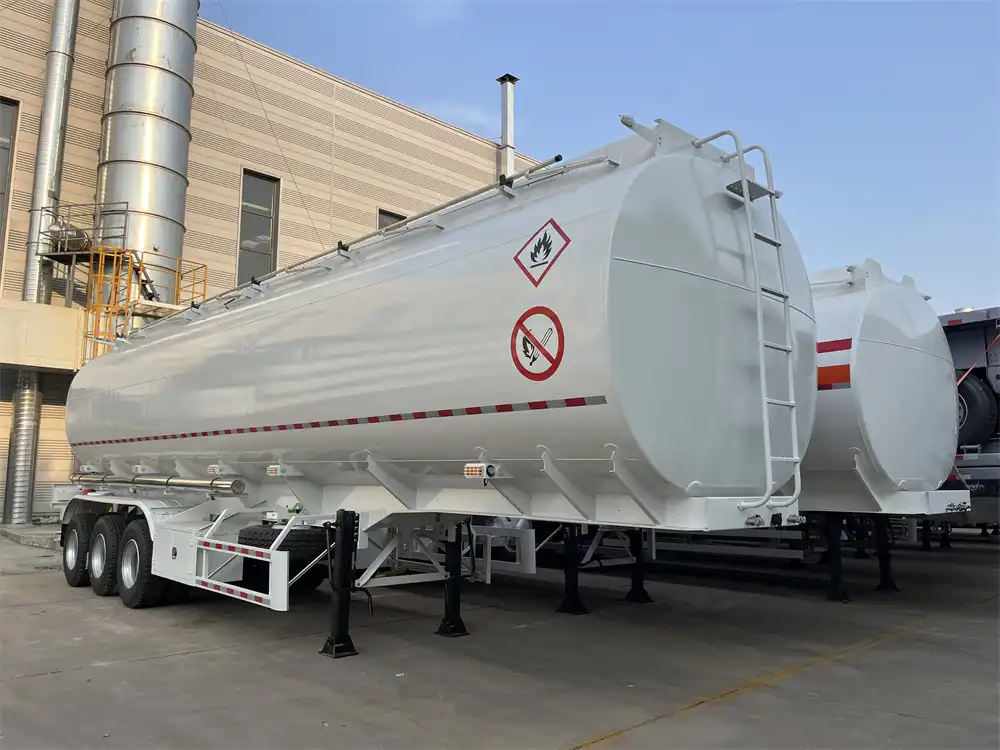
Fuel Tank Trailer
The defining feature? Multiple compartments. While a water tanker might have one big tank, fuel tanker trailers typically divide their capacity into 3-7 separate chambers. Here’s why that matters:
The Multi-Compartment Advantage
Efficiency Through Versatility A single oil tank trailer with five compartments can deliver regular unleaded to compartment 1, premium to compartment 2, and diesel to compartments 3-5—all in one trip. Compare that to running three separate trucks, burning three times the fuel, paying three drivers. The math writes itself.
Stability: The Physics of Liquid Surge Picture 40,000 liters of gasoline sloshing around in a single tank as you brake on a downhill grade. That wave wants to keep moving forward—Newton’s first law doesn’t take breaks. In a single-compartment tank, that surge can shift the center of mass so violently it’ll flip a 40-ton rig.

How Multi-compartments Work
Now divide that same load across five compartments with baffles between them. Each compartment manages its own smaller surge. The overall center of gravity stays predictable. The driver stays alive.
Regulatory Compliance Many jurisdictions limit single-compartment capacities for hazmat transport. A 50,000-liter aluminum tank trailer might need five 10,000-liter compartments to meet DOT regulations, even if carrying a single product.
Common Configurations
|
Configuration |
Compartments |
Typical Use Case |
Capacity Range |
|
Small Distribution |
2-3 |
Rural gas stations |
30,000-35,000L |
|
Standard Multi-Product |
4-5 |
Urban fuel delivery |
40,000-45,000L |
|
High-Volume |
5-7 |
Refinery transport |
50,000-60,000L |
|
Aviation Fuel |
1-2 |
Airport service |
35,000-40,000L |
The compartment count isn’t arbitrary—it’s engineered around three factors:
- Product mix requirements(how many fuel grades you’re hauling)
- Weight distribution(keeping axle loads legal)
- Surge control(smaller compartments = less dangerous slosh)
Modern fuel tank trailers also incorporate internal baffles within each compartment, creating a honeycomb of surge protection. Think of it as compartments within compartments—because when you’re hauling enough fuel to level a city block, redundancy isn’t paranoia.
1.2 Materials
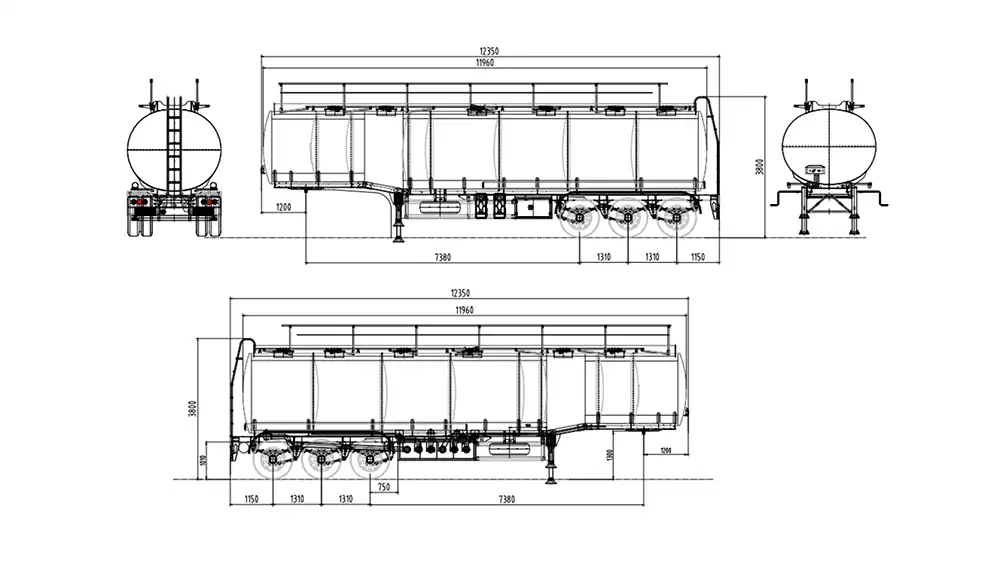
Oil Tank Trailer Drawing
Your fuel tank trailer’s material choice boils down to three options: carbon steel, stainless steel, or aluminum alloy. Each dominates different markets for good reasons—and picking wrong can cost you hundreds of thousands in lost efficiency or premature replacement.
Carbon Steel Tank Trailers
Carbon steel owns the developing world’s tanker market. Drive through India, Brazil, or Nigeria, and 8 out of 10 fuel tanker trailers you’ll see are carbon steel. Here’s why:
Strengths:
- Raw power: Carbon steel’s tensile strength hits 400-550 MPa—nearly double aluminum’s. That weld won’t crack when you hit that pothole at 60 mph.
- Price point: At $30,000-$40,000 for a basic 45,000L unit, carbon steel tanks cost 30-40% less than aluminum equivalents
- Weld simplicity: Any competent welder can repair carbon steel with basic MIG equipment. No specialized training, no exotic filler materials
- Impact resistance: Steel bends before it breaks. That matters when a forklift clips your tank at the depot
Weaknesses:
- Weight penalty: A carbon steel tank trailer weighs 15-20% more than aluminum—that’s 2,000-3,000 liters less payload per trip
- Corrosion warfare: Without galvanizing or specialized coatings, carbon steel rusts. Budget $5,000-$8,000 every 5-7 years for recoating
- Fuel consumption: Extra tare weight means burning 8-12% more diesel per mile
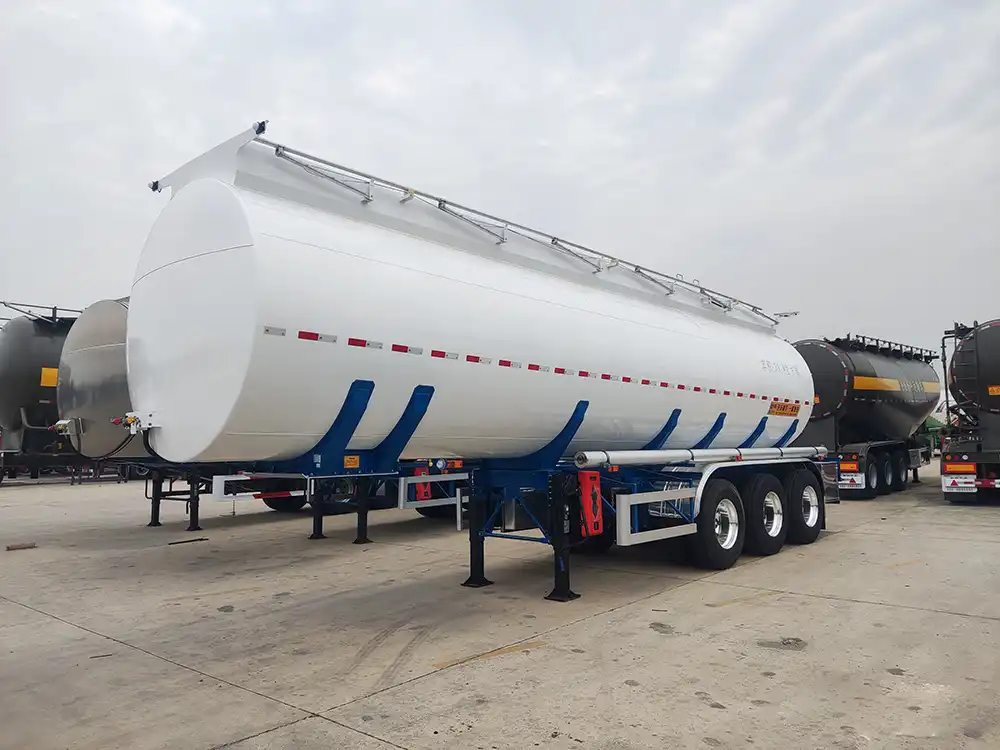
Carbon Steel Tank Trailer
Stainless Steel Tank Trailers
Stainless steel (typically 304 or 316 grade) serves niche markets—food-grade petroleum products, aviation fuel, or corrosive additives. You’re looking at premium pricing for specialized applications.
Strengths:
- Corrosion immunity: No coating required, ever. The chromium oxide layer self-heals
- Product purity: Zero rust contamination makes stainless essential for white oils and specialty fuels
- Longevity: 25-30 year service life vs. 15-20 for carbon steel
Weaknesses:
- Cost explosion: 2-3x carbon steel pricing puts these out of reach for standard diesel delivery
- Weight issues: Similar weight penalties to carbon steel without the cost advantages
- Repair complexity: Stainless welding requires TIG expertise and careful heat control

Stainless Steel Tank Trailer
Aluminum Alloy Tank Trailers
Aluminum (typically 5083 or 5454 alloy) dominates North American and European markets where payload maximization drives profits.
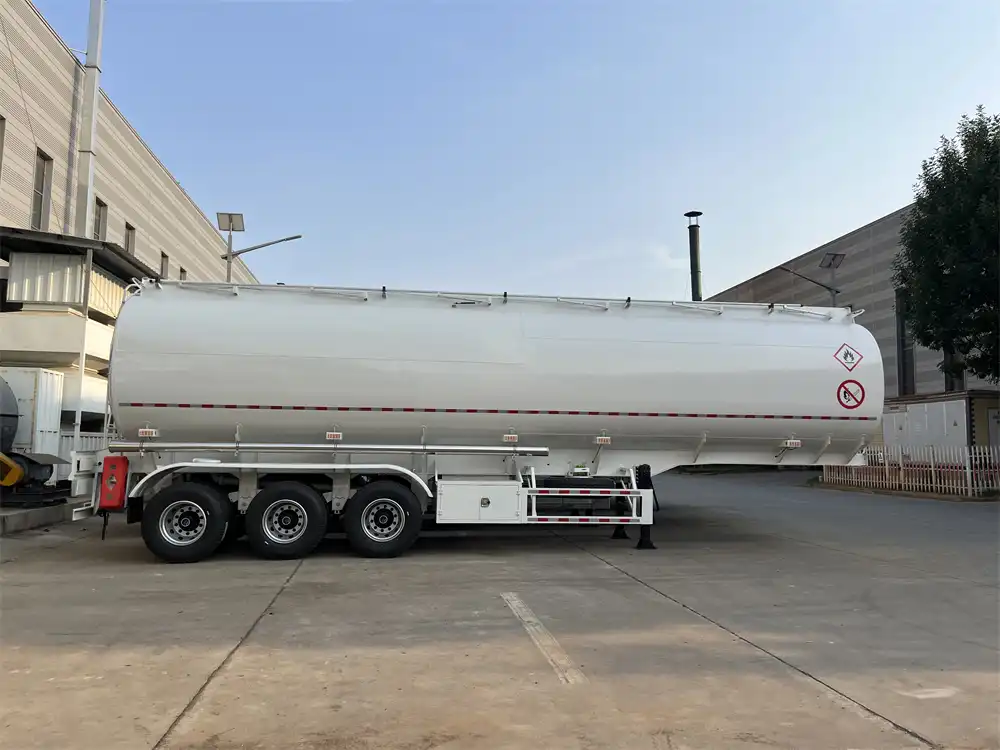
Aluminium Alloy Tank Trailer
Strengths:
- Weight advantage: Save 3,000-4,000 kg vs. steel—that’s 4,000+ extra liters of revenue per trip
- Natural corrosion resistance: Aluminum oxide layer prevents rust without coatings
- Fuel efficiency: Lower tare weight cuts fuel consumption by 10-15%
- Resale value: Aluminum tank trailers hold 60-70% value after 10 years vs. 40-50% for steel
Weaknesses:
- Strength limitations: 200-270 MPa tensile strength means thicker walls and more careful engineering
- Stress cracking: Aluminum fatigues. Those hairline cracks at weld joints aren’t suggestions—they’re ticking time bombs
- Repair requirements: Aluminum welding needs specialized TIG equipment and certified welders
- Initial investment: $50,000-$70,000 for that same 45,000L capacity
Material Selection Matrix
|
Factor |
Carbon Steel |
Stainless Steel |
Aluminum Alloy |
|
Initial Cost |
$ |
$$$ |
$$ |
|
Tare Weight |
Heavy (7,500kg) |
Heavy (7,400kg) |
Light (5,500kg) |
|
Payload Capacity |
37,500L |
37,600L |
39,500L |
|
Maintenance Cost/Year |
$2,000-3,000 |
$500-1,000 |
$1,000-1,500 |
|
Service Life |
15-20 years |
25-30 years |
20-25 years |
|
Best Application |
Developing markets, short hauls |
Food-grade fuels, chemicals |
Long-distance, multi-drop delivery |
The Bottom Line: If you’re running short routes in price-sensitive markets, carbon steel delivers. For maximum payload on interstate runs where every liter counts, aluminum pays for itself in 3-4 years. Stainless steel? Only when product purity or regulations demand it.
1.3 Parts
1.3.1 Tank Body, Heads, and Cylinder
Fuel tank trailers come in three basic shapes, and physics dictates which one you’re hauling. The shape isn’t aesthetic—it’s engineering.
Shape vs. Stability Trade-offs:
- Circular: Maximum pressure resistance, highest center of gravity (ratio: 1.0)
- Elliptical: Balanced pressure handling, lower center (ratio: 0.79)
- Rectangular: Lowest center of gravity, limited pressure capacity (ratio: 0.65)
Most diesel tanker trailers roll with elliptical cross-sections. Why? They thread the needle between pressure resistance and rollover prevention. That 21% lower center of gravity compared to circular tanks? That’s the difference between staying upright and becoming a fireball on the evening news.
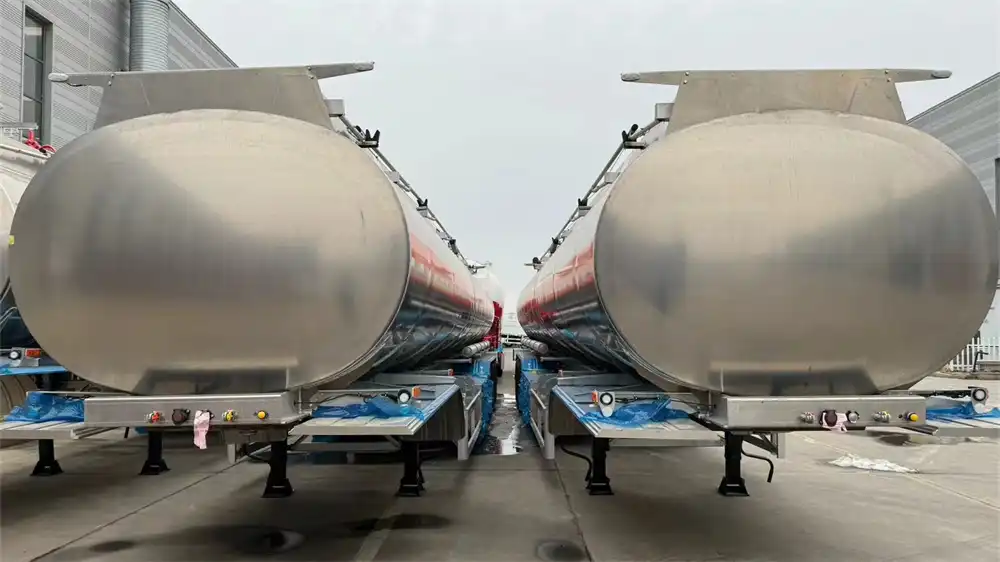
Ellipse Tank Trailer
High-pressure LPG tanks? Always circular—when you’re containing 250+ psi, structural integrity trumps stability concerns.
Manufacturing the Shell
The cylinder starts as flat steel or aluminum plates, rolled and welded into shape. The heads—those rounded end caps—get spin-stamped into unibody structures at controlled temperatures. Miss your tolerance by 4mm on roundness? That tank’s a time bomb. Industry standard: ≤3mm deviation, no exceptions.
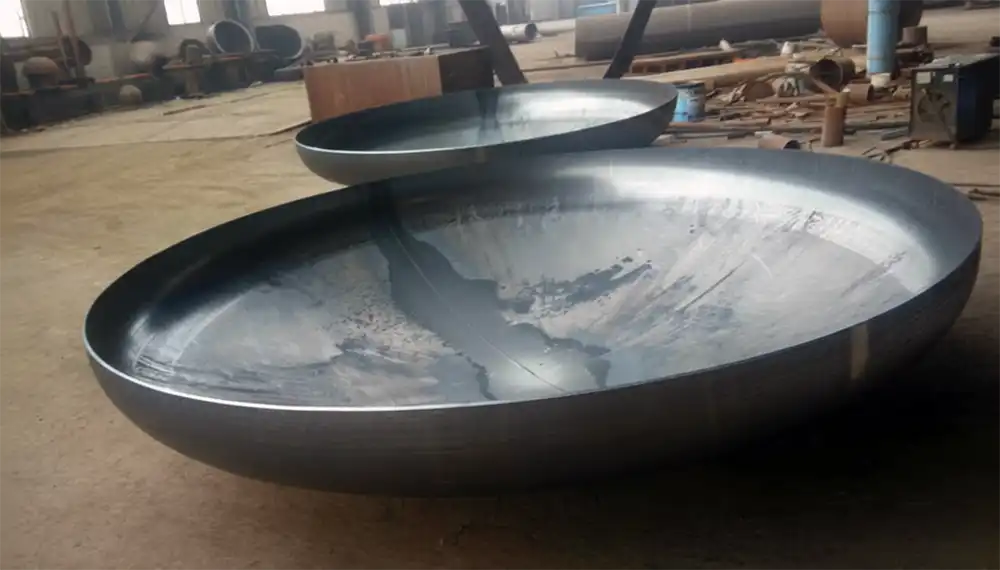
Tank Heads
Oil Baffle Plates
Baffles are the unsung heroes of fuel tank trailer safety. These internal walls turn a 10,000-liter tsunami into manageable ripples.
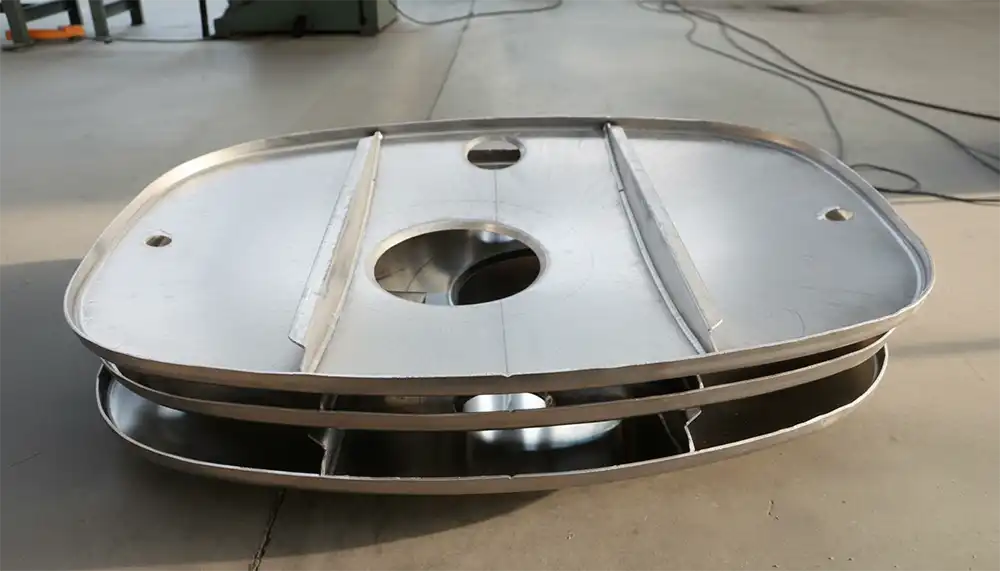
Oil Baffle Plate
Baffle Configuration:
- Longitudinal baffles: Run lengthwise, prevent side-to-side surge during turns
- Transverse baffles: Cross-sectional walls that stop front-to-back surge during braking
- Manhole requirements: Each transverse baffle needs a 550mm+ access hole for inspection/maintenance
- Staggered positioning: Multiple manholes per compartment shouldn’t align—creates stronger surge disruption
Without baffles, hard braking with 40,000 liters creates a force wave that can shift 10+ tons forward in milliseconds. That’s not driving—that’s surfing a bomb.
1.3.2 Manhole Cover Assembly
That 20-inch disc on top isn’t just an access hatch—it’s command central for vapor management and overflow prevention.
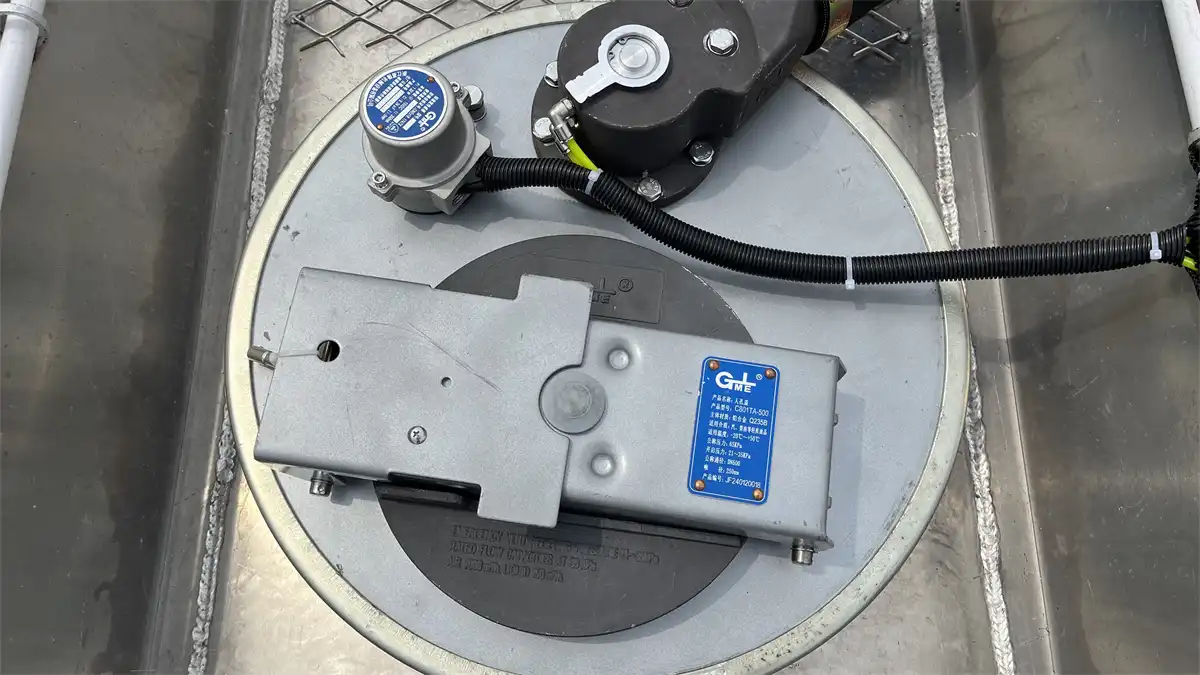
Manhole Cover
Breather Valve (Pressure/Vacuum Relief)
The breather valve maintains tank pressure within -3 to +3 psi. Here’s what happens without it:
- Over-pressure: Tank ruptures like a balloon
- Vacuum: Tank implodes like a crushed soda can
Construction specs:
- Body: 316 stainless steel with nickel-cadmium coating
- Components: Acid-resistant stainless throughout
- Configuration: Small tanks (≤35,000L) use one valve total; large tanks need one per compartment
Spill-Proof Sensor
Think of it as your tank’s “check engine” light for overfilling. The sensor triggers an audible alarm when liquid levels change rapidly or approach maximum capacity. When that whistle screams during loading, you’ve got seconds to shut the valves before petroleum decorates the tarmac.
Oil Vapor Recovery Valve
Every gallon of gasoline can produce 5 cubic feet of vapor. Without vapor recovery, you’re literally watching profits evaporate. Modern recovery systems condense these vapors back to liquid, capturing 95%+ of emissions. That’s EPA compliance and recovered product in one valve.
1.3.3 Oil Line System
The plumbing that moves 3,000 gallons per minute needs more than hardware store fittings.
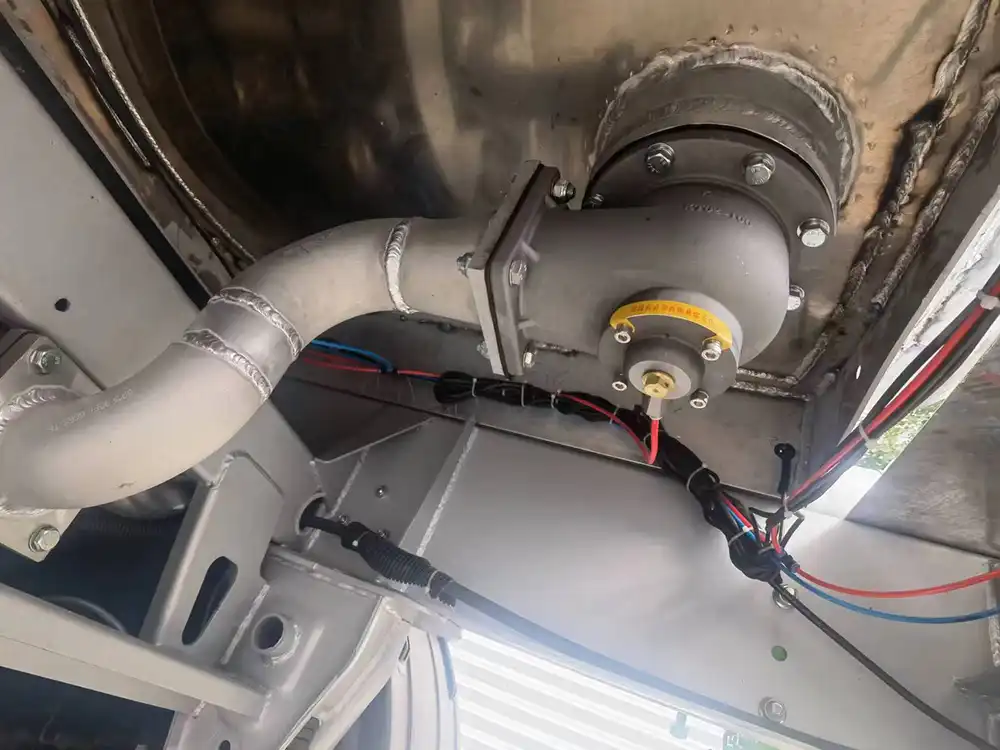
Bottom Valve
Bottom Valve (Emergency Shutoff)
The bottom valve is your last line of defense in a crash. Specifications:
- Activation: Automatic closure in <5 seconds on impact
- Shear design: Breaks away clean if torn off, seals tank instantly
- Manual override: Cable-operated emergency shutdown from cab
- Testing requirement: Monthly function checks [VERIFY: Inspection frequency per DOT]
Fuel Outlet Valve
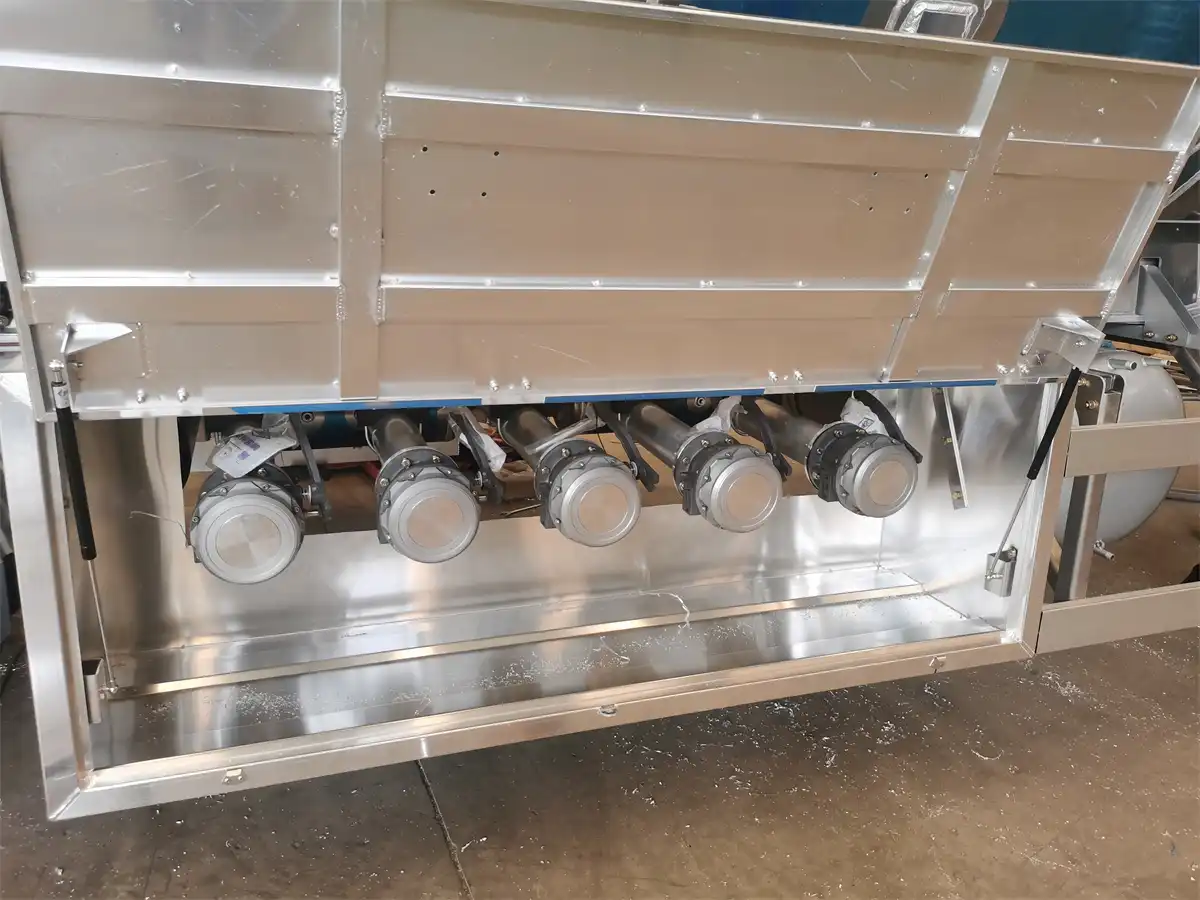
Fuel Outlet Valve
Engineered for high-flow discharge without pressure buildup:
- Flow rate: 500-1,000 gallons/minute depending on size
- Dry-break coupling: Zero spillage when disconnecting—even under pressure
- Internal geometry: Venturi-effect design minimizes cavitation
- Materials: Aluminum body with Viton seals for chemical resistance
Pro tip: That satisfying click when you disconnect? That’s $50 worth of diesel NOT spilling on your boots.
1.4 Top or Bottom Loading
Top Loading: The Old Way That Won’t Die
Top loading means climbing that ladder, opening the manhole, and dropping a fill pipe down. Still common in developing markets and older facilities that haven’t upgraded infrastructure. Here’s why it’s a problem:
The Vapor Cloud Death Trap
- Gasoline evaporates at 1-8% by volume during top loading
- Creates a vapor cloud 3-5 feet above the manhole
- Concentration hits 20,000-50,000 ppm—way past the 300 ppm exposure limit
- One static spark in that cloud? You’re the evening news
Economic Losses
- 5-1% product loss through evaporation on a 45,000L load
- That’s 225-450 liters—literally profits vanishing into air
- At $1.50/liter, you’re burning $337-$675 per load
Time Penalty
- Top loading: 45-60 minutes for a full fuel tank trailer
- Worker exposure for entire duration
- Manual gauging required between compartments
Bottom Loading: Why Modern Operators Don’t Climb Ladders
Bottom loading connects directly to valves at the tank’s base. The fuel enters below liquid level, eliminating vapor generation. Every modern fuel tanker trailer comes bottom-loading ready—here’s why:
Safety Revolution
- Vapor stays inside the closed system
- Internal vapor recovery captures 99%+ of emissions
- Worker stays on the ground—no ladder falls, no vapor exposure
- Automatic overfill protection stops flow at preset levels
Speed Advantage
- Bottom loading: 25-35 minutes for the same 45,000L
- Flow rates hit 3,000-4,000 liters/minute vs. 1,500-2,000 for top loading
- Sequential compartment filling without repositioning
The Money Math
- Product recovery: Save those 450 liters per load
- Time savings: 20-30 minutes = one extra delivery per day
- Insurance breaks: Bottom-loading facilities get 15-25% lower premiums
- Worker comp claims drop 70%+ when you eliminate ladder work
Loading System Components
Bottom Loading Requirements:
|
Component |
Function |
Specification |
|
API Adapter |
Standardized connection |
4″ or 6″ depending on flow rate |
|
Vapor Recovery Line |
Returns vapors to storage |
3-4″ diameter, separate from product line |
|
Overfill Sensor |
Automatic shutoff |
Optical or thermistor type |
|
Grounding Cable |
Static discharge |
<10 ohms resistance, tested monthly |
|
Dry-Break Couplings |
Spillage prevention |
Zero-leak disconnection under pressure |
Top Loading (Where Still Used):
- Rural locations without bottom-loading infrastructure
- Emergency transfers between trucks
- Specialty products requiring dedicated lines
- Backup when bottom-loading equipment fails
Regulatory Push
The writing’s on the wall for top loading:
- EPA Stage I: Requires vapor recovery for loading operations
- OSHA benzene standard: Limits exposure to 1 ppm TWA
- EU ADR regulations: Mandate closed loading systems for Class 3 liquids
- Insurance requirements: Many carriers won’t cover top-loading operations

Tanker Loading
The Verdict: If you’re still top loading in 2025, you’re either grandfathered in or counting days until compliance officers shut you down. Bottom loading isn’t just better—it’s becoming the only legal option.
1.5 Safety Accessories
Safety accesories can ensure that the high-pressure reaches its destination without any leakages, incidents or accidents.
The accessores include a safety valve, an emergency shutting-off system, and an electostatic eliminating device.
1.5.1 Safety Valve

Safety Valve
The safety valve is your tank’s pressure referee—it decides when enough is enough. Unlike the breather valve that handles normal pressure fluctuations, this is your emergency backup when things go sideways.
Operating Parameters:
- Opening pressure: ≤1.1x design pressure (typically 3.5 psi for atmospheric tanks)
- Full flow achieved: Within 10% above opening pressure
- Closing pressure: ≥0.8x opening pressure (prevents flutter)
- Flow capacity: Must evacuate vapor faster than worst-case generation rate
When It Saves Your Bacon:
- Breather valve fails shut during loading (pressure builds)
- Fire exposure heats tank contents (vapor expansion)
- Overfilling attempts to exceed compartment capacity
- Temperature swings from -40°F morning to 110°F afternoon
Critical Specs:
- Response time: <500 milliseconds from trigger to full open
- Reseal reliability: 10,000 cycles minimum without leak
- Materials: 316 stainless internals, Viton seals
- Testing: Annual bench test required [VERIFY: DOT inspection interval]
1.5.2 Emergency Shutoff System

Emergency Shutting Off Valve
Think of the emergency shutoff as your fuel tank trailer’s kill switch—multiple ways to slam the door when disaster strikes.
Activation Triggers:
|
Trigger Type |
Activation Method |
Response Time |
Reset Requirement |
|
Manual Cable |
Pull from cab or rear |
<2 seconds |
Manual at valve |
|
Thermal Fusible Link |
Melts at 212°F/100°C |
Instant |
Replace link |
|
Pneumatic Loss |
Air pressure drops below 40 psi |
<5 seconds |
Restore air + manual |
|
Impact Shear |
Physical separation |
Instant |
Component replacement |
|
Remote Emergency |
Wireless shutoff (optional) |
<3 seconds |
Key reset |
Real-World Scenarios:
- Hose failure during unloading: Shutoff stops flow before you paint the parking lot with diesel
- Fire at loading rack: Thermal link triggers at 212°F, isolating tank contents
- Rollover accident: Shear section breaks clean, valve seals automatically
- Drive-away protection: Forgot to disconnect? Breakaway cable triggers shutoff
The Numbers That Matter:
- Closure force: 50-80 ft-lbs of torque
- Leak rate after activation: <1 drop per minute
- Operating temperature range: -40°F to +250°F
- Minimum wire rope strength: 3,000 lbs
1.5.3 Electrostatic Elimination Device
Static electricity and petroleum vapors—chemistry’s most explosive dating app. Your fuel tank trailer generates static three ways:
- Flow friction: 10,000-50,000 volts from fuel rushing through pipes
- Splash filling: Droplets create charge separation
- Road friction: Tires on asphalt build chassis charge
Grounding System Requirements:
- Resistance to ground: <10 ohms (tested before each load)
- Cable specification: 2/0 AWG minimum, 20-foot reach
- Clamp design: Copper alloy, sharp teeth penetrate paint/rust
- Bonding between compartments: <1 ohm resistance
- Monitoring: LED or audible confirmation of ground
Static Control Chain:
- Primary ground cable: Truck chassis to earth ground at rack
- Bonding jumpers: Connect all compartments to common ground
- Conductive additives: Some terminals add SDA (Static Dissipator Additive)
- Humidity control: Loading areas maintain >50% humidity where possible
The Spark That Didn’t Happen: A properly grounded fuel tanker trailer dissipates charge continuously. Without it? One spark with vapor concentration between 1.4-7.6% and you’re explaining to investigators why there’s a crater where the loading rack used to be.
Additional Safety Systems
Modern fuel tank trailers layer safety redundancies:
Rollover Protection:
- Internal valves close automatically at >75° tilt
- Prevents cargo spillage even if tank inverts
- Required on all new builds since 2015 [VERIFY: Implementation date]
Overfill Prevention:
- Optical sensors at 95% capacity
- Automatic loading shutdown
- Separate high-level alarm at 90%
Fire Suppression (Optional but Smart):
- Dry chemical systems in equipment boxes
- Thermal activation at 300°F
- 20-30 second discharge duration
- Covers pump, valve, and meter areas
The Safety Investment: Complete safety package adds $8,000-$12,000 to your fuel tank trailer cost. Your insurance company will credit back 20-30% in premium reductions. First accident prevented? Priceless.
Chapter 2: How To Inspect The Welding Quality Of The Tank
A fuel tank trailer is only as strong as its weakest weld. That hairline crack you can’t see? It’s waiting to turn 45,000 liters of diesel into an environmental disaster. Here’s how professionals catch failures before they happen.
Welders follow Welding Procedure Specifications (WPS)—but following procedures and achieving quality are different animals. Every fuel tanker trailer needs nondestructive testing (NDT) before it hauls a single liter. Miss a defect, and you’re not just risking cargo—you’re betting lives.
2.1 Magnetic Powder Inspection

Magnetic Powder Inspection
Magnetic particle testing finds the cracks hiding at or near the surface of your carbon steel tank. The physics is simple: magnetize the steel, spread iron powder, watch it cluster around defects like ants at a picnic.
How It Works
- Magnetize the weld zoneusing AC or DC yoke (portable) or coil (fixed)
- Apply magnetic powder(dry or wet suspension)
- Defects disrupt magnetic field, creating “flux leakage”
- Powder accumulatesat disruption sites, revealing cracks
The Good
- Speed demon: Test 50 feet of weld per hour
- Cheap date: $200-$500 per tank inspection
- Surface sensitivity: Catches cracks as small as 0.001″
- Works through paint: Detects flaws under 0.003″ coating
- Field-friendly: Portable equipment, no lab required
The Limits
- Carbon steel only: Your aluminum tank trailer laughs at magnets
- Surface/near-surface only: Misses deep defects beyond 0.25″
- Directional blindness: Cracks parallel to magnetic field hide
- Demagnetization required: Skip this, watch tools stick to your tank
- False positives: Grinding marks and scratches trigger false alarms
Best for: Initial inspection of carbon steel fuel tank trailer welds, finding fatigue cracks during maintenance
2.2 Ultrasonic Welding Inspection

Ultrasonic Inspection
Ultrasonic testing sends sound waves through metal like sonar through water. Hit a crack, get an echo. Simple concept, complex execution.
Technical Specs
- Frequency range: 2-10 MHz for tank trailers
- Penetration depth: Up to 12″ in steel, 6″ in aluminum
- Minimum detectable flaw: 2% of material thickness
- Scan speed: 6-12 inches per second
- Coverage: 100% volumetric inspection possible
Advantages Over Other Methods
- Deep penetration: Finds buried defects magnetic testing misses
- Precise sizing: Measures crack depth within ±0.5mm
- Single-side access: Test from outside while tank’s full
- Digital records: Waveforms provide permanent inspection proof
- Thickness measurement: Catches corrosion thinning
Reality Check
- Operator dependency: Bad technician = missed defects
- Surface prep needed: Rough welds scatter signal
- Coupling required: No gel contact = no reading
- Training intensive: 80-hour minimum certification
- Interpretation challenges: Is that echo a crack or just geometry?
Best for: Critical welds on fuel tanker trailers, thickness monitoring, pre-purchase inspections
2.3 Penetrant Flaw Detection

Penetrate Flaw Detection
Dye penetrant testing is welding inspection for dummies—spray on red dye, wipe off excess, spray on developer, watch cracks bleed red. Works on everything from aluminum tank trailers to stainless steel fittings.
The Process
|
Step |
Action |
Time |
Critical Factor |
|
1. Clean |
Degrease surface completely |
5-10 min |
Any oil blocks penetrant |
|
2. Apply Penetrant |
Spray or brush red dye |
1 min |
Complete coverage essential |
|
3. Dwell Time |
Let capillary action work |
10-30 min |
Temperature dependent |
|
4. Remove Excess |
Wipe with cleaner |
5 min |
Don’t over-clean cracks |
|
5. Apply Developer |
White powder draws out dye |
1 min |
Even coating required |
|
6. Inspect |
Look for red bleed-out |
10-60 min |
Time-dependent sensitivity |
Where It Shines
- Universal application: Steel, aluminum, plastics—if it’s not porous, it works
- Complex geometry: Reaches where other methods can’t
- Cheap and portable: $50 kit does hundreds of inspections
- Visual results: Red on white—interpretation for dummies
- Batch processing: Test 20 parts simultaneously
Where It Fails
- Surface breaks only: Internal defects stay hidden
- Messy process: Red dye everywhere
- Temperature sensitive: Below 40°F or above 125°F degrades results
- Multi-step dependence: Skip one step, miss the crack
- Environmental concerns: Solvent disposal requirements
Best for: Field verification of aluminum tank trailer repairs, valve seat inspections, quick surface checks
2.4 X-Ray Flaw Detection

X Ray Flaw Detection
Radiographic testing is the gold standard—shoot radiation through metal, capture image, see everything. It’s also expensive, slow, and requires clearing a 100-foot radius unless you enjoy radiation exposure.
The Nuclear Option
Equipment Classes:
- X-ray machines: 100-450 kV for fuel tank trailer thickness
- Gamma sources: Iridium-192 for field work
- Digital systems: Real-time imaging, no film processing
- Computed radiography: Reusable plates, digital storage
What It Catches That Others Miss:
- Incomplete penetration in thick welds
- Porosity clusters invisible to surface methods
- Internal corrosion in used tank trailers
- Hidden cracks in multi-pass welds
- Material inclusions from manufacturing
Cost-Benefit Analysis
|
Factor |
X-Ray |
Other NDT Methods |
|
Initial Equipment |
$50,000-$200,000 |
$5,000-$30,000 |
|
Per-Inspection Cost |
$2,000-$5,000 |
$200-$1,000 |
|
Defect Detection Rate |
95-99% |
70-90% |
|
Documentation |
Permanent film/digital |
Written reports |
|
Regulatory Acceptance |
Universal |
Variable |
|
Safety Requirements |
Radiation badges, barriers |
Basic PPE |
Best for: New fuel tanker trailer certification, insurance inspections, failure analysis after incidents
NDT Selection Guide
Pick your testing method based on what you’re hunting:
- Surface cracks on steel: Magnetic particle
- Deep weld defects: Ultrasonic
- Aluminum surface flaws: Dye penetrant
- Complete documentation: X-ray
- In-service inspection: Ultrasonic + magnetic
- Pre-delivery certification: X-ray + ultrasonic
Remember: No single method catches everything. Smart operators use multiple NDT methods—redundancy isn’t paranoia when you’re hauling 45,000 liters of explosive liquid.
Chapter 3: How to Buy a Tank Trailer
Buying a fuel tank trailer isn’t like picking a pickup truck. Get it wrong, and you’re not just stuck with a lemon—you’re hauling 45,000 liters of litigation waiting to happen. Here’s how to separate serious manufacturers from cowboys with welding torches.
3.1 Standards and Certification
Your fuel tanker trailer needs paperwork—lots of it. Skip the certification homework, and you’ll own a very expensive lawn ornament that’s illegal to operate.
Regional Compliance Requirements
United States:
- DOT 406/407/412: Specification codes for petroleum, chemical, and corrosive tanks
- MC-306 (older units): Grandfather clause applies, but modifications trigger updates
- FMVSS standards: Lighting, braking, coupling requirements
- EPA requirements: Vapor recovery, spill prevention
- State specifics: California CARB, Texas Railroad Commission rules [VERIFY: Current state variations]
European Union:
- ADR certification: Mandatory for dangerous goods transport
- EN 13094: Tank construction standards
- TPED (Transportable Pressure Equipment Directive): For pressure vessels
- National additions: TÜV (Germany), APRAGAZ (France)
Common International:
- UN portable tank codes: T11, T14 for various petroleum products
- ASME certification: For pressure vessels over 15 psi
- ISO 9001/14001: Quality and environmental management
What Certification Actually Means
|
Certification |
What It Proves |
Red Flag If Missing |
|
DOT Registration |
Legal to operate in US |
Can’t cross state lines |
|
Pressure Test Certificate |
Tank integrity verified |
Insurance won’t cover |
|
Material Mill Certificates |
Steel/aluminum meets spec |
Structural failure risk |
|
Welding Certifications |
Welder qualified for code |
Warranty likely void |
|
Third-Party Inspection |
Independent verification |
Bank won’t finance |
The $50,000 Question: Is the manufacturer’s certification current? Certificates expire. That bargain fuel tank trailer with 2019 papers needs complete recertification—add $10,000-$15,000 to your budget.
3.2 Inspect the Supplier's Strength
Forget glossy brochures. Here’s what separates real manufacturers from garage shops pretending to build fuel tanker trailers:
Manufacturing Capability Checklist
The Non-Negotiables:
- Automated welding stations: Hand welding alone = inconsistent quality
- Pressure testing facility: In-house capability, not outsourced
- X-ray inspection equipment: Or certified third-party arrangement
- Roll forming capacity: For tank shells without excessive welding
- Heat treatment ovens: For stress relief on aluminum tank trailers
The Nice-to-Haves:
- CNC plasma cutting for precision parts
- Robotic welding for critical seams
- 3D modeling capability for custom designs
- In-house painting/coating facility
Due Diligence Deep Dive
Factory Audit Questions:
- Production volume: How many fuel tank trailers built annually? Under 50 = hobby shop. Over 500 = real manufacturer.
- Welding procedures: Ask for their WPS documentation. Blank stares = run away.
- Material sourcing: Mill certificates on hand? Traceable steel/aluminum sources?
- Testing protocols:
- Hydrostatic test pressure and duration?
- NDT methods used on every unit?
- Documentation provided with delivery?
- Warranty terms: Real manufacturers offer 3-5 years structural, 1-2 years components. “As-is” sales = disaster incoming.
Financial Health Indicators
Green Flags:
- 10+ years in business
- Banking references available
- Performance bonds obtainable
- Insurance certificates current
- Multiple dealer locations
Red Flags:
- “Cash only” payment terms
- No physical address visits allowed
- Certificates from unknown agencies
- Litigation history (check court records)
- Frequent company name changes
The Reference Check Reality
Don’t just call references—visit them. See their fuel tank trailers in operation. Questions that matter:
- Actual delivery time promised?
- Hidden costsafter signing?
- Warranty claimresponse time?
- Parts availabilityafter 5 years?
- Would you buy again?(Watch their face, not their words)

Supplier’s Strength
Price vs. Value Matrix
That $35,000 fuel tanker trailer looks tempting next to the $65,000 branded unit. Here’s what you’re really buying:
|
Price Range |
What You Get |
Hidden Costs |
5-Year TCO |
|
$30-40K |
Basic carbon steel, minimal features |
Frequent repairs, downtime |
$65-75K |
|
$45-55K |
Mid-tier, standard features |
Moderate maintenance |
$60-70K |
|
$60-75K |
Premium aluminum, full safety |
Minimal issues |
$70-85K |
|
$80K+ |
Custom specs, extended warranty |
Almost none |
$85-95K |
The Math: Cheap fuel tank trailer + 20% more downtime + higher insurance + lost contracts = bankruptcy
Pre-Purchase Inspection Protocol
Never buy without:
- Pressure test witnessed(not just certified—watch it happen)
- Complete NDT report(all welds, not samples)
- Material certificatesfor every component
- Dimensional verificationagainst drawings
- Operational testof all valves/systems
- Paint thickness readings(shortcuts here predict shortcuts everywhere)
Bring an expert. Hiring a third-party inspector costs $2,000-$3,000. Finding catastrophic flaws before purchase? Priceless.
Chapter 4: Driving a Fuel Tank Trailer Safely
You’re piloting 80,000 pounds of physics and chemistry down the highway. The load behind you doesn’t care about your schedule, your experience, or your confidence. It follows the laws of momentum and fluid dynamics—period. Master these principles or become a statistic.
Loading: Where Disasters Begin

Tank Trailer Leakage
Half your accidents are determined before you leave the rack. Load wrong, and you’re driving a 45,000-liter water balloon looking for a reason to burst.
The Liquid Surge Reality
Partial loads are the enemy. A fuel tank trailer filled to 50% capacity creates a surge force that can exceed 8,000 pounds slamming forward during hard braking. That’s like having a Ford F-250 loose in your tank, ramming the front wall every time you stop.
Loading Rules That Save Lives:
|
Fill Level |
Surge Risk |
Stability |
Legal? |
Recommendation |
|
95-98% |
Minimal |
Excellent |
Yes |
Optimal for highway |
|
80-94% |
Low |
Good |
Yes |
Standard operation |
|
50-79% |
High |
Poor |
Yes* |
Avoid if possible |
|
20-49% |
Extreme |
Dangerous |
Yes* |
Emergency only |
|
<20% |
Moderate |
Fair |
Yes |
Empty runs only |
*Legal but insurance may deny claims for surge-related accidents
Critical Loading Calculations:
- Expansion allowance: Gasoline expands 1% per 15°F temperature rise
- Outage requirements: Minimum 2% vapor space (900 liters on 45,000L load)
- Weight distribution: No compartment should exceed others by >10%
- Temperature compensation: Load 500 liters less in summer vs. winter
Pre-Loading Valve Checklist
Before that first drop flows:
- Internal valves: Closed and locked (feel for the click)
- Bottom outlet valves: Sealed with dust caps in place
- Vapor recovery: Connected and tested at <10 ohms
- Emergency shutoffs: Cables free, fusible links intact
- Pressure relief valves: Pop-tested within last 12 months
- Overfill sensors: LED test shows green
Miss one valve, and you’re the driver explaining to hazmat why there’s a rainbow sheen across three lanes of interstate.
Pre-Drive Inspection: Your Legal Lifeline
The 360-Degree Walk
Start at the nose, work clockwise:
- Manholes: Latched, locked, gaskets visible
- Dome covers: No product weeping at edges
- Shell integrity: No fresh stains indicating pin-hole leaks
- Undercarriage: Valves closed, no drips at flanges
- Suspension: Airbags inflated equally, no broken leaves
- Tires: 100 psi minimum, tread depth >4/32″
- Lights: Every single one—DOT inspectors count
- Placards: Current, correct class, all four sides
Time required: 15 minutes Citations avoided: $2,000-$10,000 worth Lives saved: Immeasurable
Driving Dynamics: The Physics You Can't Ignore
-
Controlling Surge Forces
Steady pressure braking: Once you commit to stopping, keep steady pedal pressure. Pumping brakes creates harmonic surge—each pump amplifies the wave.
The surge timeline:
- 0-1 second: Initial brake application
- 1-3 seconds: Liquid rushes forward
- 3-5 seconds: Wave hits front, rebounds
- 5-7 seconds: Secondary surge (often causes jackknife)
Countermeasures:
- Begin braking 50% earlier than empty
- Maintain consistent deceleration rate
- Never release brakes during surge cycle
- Use engine brake as primary, service brake as backup
-
Stopping Distance Mathematics
|
Condition |
Empty Tank |
Full Tank |
Partial Load |
|
Dry road |
250 feet |
300 feet |
350 feet |
|
Wet road |
400 feet |
450 feet |
550 feet |
|
Snow/ice |
800 feet |
900 feet |
1,100 feet |
At 55 mph, add 20% for each 10 mph increase
Why partial loads stop slowest: Surge momentum adds to forward motion. That sloshing fuel wants to keep going, dragging your fuel tank trailer with it.
-
Curve Navigation
The rollover formula: Speed² ÷ (Radius × 15) = Rollover risk factor
- Factor >1.0 = You’re going over
- Factor 0.8-1.0 = Tire squealing warning
- Factor <0.6 = Safe zone
Real example: 35 mph on a 150-foot radius ramp: 35² ÷ (150 × 15) = 1,225 ÷ 2,250 = 0.54 (safe)
Same curve at 45 mph: 0.90 (you’re gambling)
-
Skid Recovery
Drive wheel skid: Ease off accelerator, don’t brake, steer straight Trailer skid: Accelerate slightly to pull trailer straight Jackknife imminent: You have 1.5 seconds to respond
- Release brakes completely
- Accelerate if possible
- Steer into the skid
- Pray you started early enough
Prevention beats recovery: New drivers practice recovery. Veterans never need to.
-
Speed Management
Posted limits assume ideal conditions with passenger cars. Your fuel tanker trailer needs different math:
Adjust posted speeds:
- Curves: -15 mph minimum
- Rain: -10 mph
- Empty tank: -5 mph (less traction)
- Partial load: -10 mph
- Night: -5 mph
- Construction zones: -15 mph or 45 mph max
The veteran’s rule: Drive the speed that lets you sleep at night, not the speed that gets you home faster.
Emergency Scenarios
Brake failure protocol:
- Engine brake maximum
- Pump brakes to build pressure
- Find escape ramp or uphill grade
- Rub barrier wall if necessary
- Never roll it—spilled fuel burns
Fire on board:
- Stop immediately (momentum feeds fire)
- Evacuate 300-foot radius
- Don’t fight petroleum fires—let professionals handle
- Call 911 before company (legal requirement)
Rollover imminent:
- Don’t correct—ride it out
- Stay belted
- Shut off engine if possible
- Prepare for fuel spillage
- Exit uphill side only
Chapter 5: Fuel Tank Trailer Maintenance Protocols
Maintenance isn’t optional—it’s federal law. Skip it, and you’re not just risking breakdowns. You’re betting your CDL, your company’s operating authority, and potentially some jail time if that missed inspection causes fatalities.
A fuel tank trailer operates under more stress than almost any other commercial vehicle. Temperature swings from -40°F to 140°F. Pressure cycles thousands of times monthly. Corrosive additives eating at seals. Here’s what keeps these rolling bombs from becoming actual bombs.
Critical Component Inspection Schedule
Valves and Pressure Systems
Your fuel tanker trailer has 20-30 valves. Each one is a potential leak point, and leaks mean fire, fines, or both.
Monthly Valve Maintenance:
|
Valve Type |
Check Points |
Failure Signs |
Action Required |
|
Internal Emergency |
Spring tension, seal integrity |
Slow to close, dripping |
Rebuild kit or replace |
|
Pressure Relief |
Pop-off at 3.5 psi ±0.2 |
Won’t reseat, corroded spring |
Replace (never adjust) |
|
Bottom Outlet |
Handle torque, packing gland |
Stiff operation, weeping |
Repack or replace seals |
|
Vapor Recovery |
Ball float movement |
Sticking, won’t seal |
Clean or replace float |
|
API Adapter |
Cam locks, gasket |
Hard to connect, leaks |
New gasket, lubricate |
The freeze factor: Below 32°F, condensation in valves freezes. Frozen valves don’t close. Add methanol injection systems in cold climates—$2,000 investment prevents $200,000 disasters.
Lubrication specs:
- Food-grade silicone for product contact areas
- Never use petroleum-based lubricants (degrades seals)
- Apply every 1,000 cycles or 90 days
- Document each application (DOT requires records)
Pressure gauge calibration:
- Test monthly against master gauge
- ±2% accuracy required
- Replace at 3% drift
- Annual certified calibration mandatory
Tank Shell Integrity
The tank is your primary containment. When it fails, everything fails.
Visual Inspection Zones:
- Weld seams: Look for stress cracks, especially at baffle attachments
- Shell deformation: Measure suspicious dents (>2″ deep = out of service)
- Corrosion patterns:
- Carbon steel: Surface rust OK, pitting >1/16″ deep is not
- Aluminum: White powder indicates corrosion—investigate immediately
- Impact damage: New dents since last inspection need ultrasonic testing
Leak Detection Methods:
- Soap test: Mix Dawn dish soap 1:10 with water, spray all joints
- Pressure decay: Pressurize to 5 psi, measure drop over 30 minutes (<0.5 psi OK)
- Vacuum test: Pull -5″ Hg, should hold 20 minutes minimum
- Dye penetrant: Annual inspection of high-stress areas
Surface Maintenance:
- Carbon steel tanks:
- Wire brush rust annually
- Prime bare metal within 4 hours
- Recoat every 5-7 years ($8,000-$12,000)
- Aluminum tanks:
- Acid wash every 2 years
- Polish for appearance only
- Never use steel brushes (embeds iron, causes corrosion)
Tire and Suspension
A fuel tank trailer’s weight varies 30,000 pounds between loaded and empty. Your suspension and tires take that beating daily.
Tire Management Protocol:
|
Check Point |
Frequency |
Specification |
Out-of-Service |
|
Pressure |
Daily |
100-110 psi cold |
<90 psi |
|
Tread depth |
Weekly |
6/32″ minimum |
2/32″ |
|
Sidewall condition |
Daily |
No bulges/cuts |
Cord showing |
|
Valve stems |
Weekly |
Metal only, capped |
Cracked/leaking |
|
Age |
Annually |
Date code check |
>7 years |
Why fuel tankers eat tires: Chemical exposure weakens rubber. Petroleum products cause 30% faster degradation. Budget for replacement every 100,000 miles vs. 150,000 for dry vans.
Suspension inspection:
- Air bags: Equal pressure side-to-side (±5 psi)
- Leaf springs: No cracks at eyes or center bolts
- Shock absorbers: No leaks, proper damping
- Ride height: Level when empty (adjust air pressure)
Bolt Torque Specifications
Vibration loosens everything. One loose bolt starts a cascade failure.
Critical Torque Points:
- U-bolts: 300-350 ft-lbs (check monthly)
- Spring hanger bolts: 450-500 ft-lbs
- Fifth wheel: 200-250 ft-lbs
- Manhole cover: 50-75 ft-lbs (over-tightening damages gasket)
- Valve flanges: 30-40 ft-lbs (sequence matters—star pattern)
The 100-hour rule: After any major repair, retorque all affected bolts at 100 operating hours. Thermal cycling and vibration cause initial settling.
Documentation Requirements
The paper trail keeps you legal. Missing logs = violations = shutdown orders.
Required Records
Daily: Pre-trip inspection report (keep 3 months) Monthly: Valve function tests, pressure gauge calibration Quarterly: Complete undercarriage inspection Annual:
- DOT annual inspection (form MCS-150)
- Pressure vessel certification
- Internal tank inspection
- NDT of critical welds
Electronic logging: Paper burns in accidents. Digital records with cloud backup prove compliance even if your truck becomes scrap metal.
Maintenance Cost Reality
|
Service |
Frequency |
Cost |
Skip It And… |
|
Valve rebuilds |
Annual |
$2,000-3,000 |
Leak = $10,000 EPA fine |
|
Tank recoating |
5-7 years |
$8,000-12,000 |
Structural failure = total loss |
|
Tire replacement |
100,000 miles |
$3,000-4,000 |
Blowout = rollover risk |
|
DOT inspection |
Annual |
$500-800 |
Operating authority revoked |
|
Complete PM service |
30,000 miles |
$1,500-2,000 |
Roadside breakdown = $5,000+ |
Annual maintenance budget: 10-15% of fuel tank trailer value Cost of neglect: 100% of trailer value + lawsuits + criminal charges
The Maintenance Schedule That Saves Lives
Daily (driver responsibility):
- Tire pressure
- Valve positions
- Leak check
- Lights/markers
Weekly:
- Detailed undercarriage inspection
- Brake adjustment check
- Suspension components
- Documentation review
Monthly:
- Valve operation tests
- Torque critical bolts
- Pressure system calibration
- Corrosion inspection
Annually:
- Complete NDT inspection
- Internal tank inspection
- Pressure certification
- Component rebuilds
Remember: You’re not maintaining equipment—you’re maintaining the barrier between 45,000 liters of explosive liquid and the minivan full of kids in the next lane.
The Bottom Line on Fuel Tank Trailers
You’re now equipped with knowledge that separates professionals from wannabes in the fuel transport industry. A fuel tank trailer isn’t just steel or aluminum shaped into a cylinder—it’s engineered redundancy keeping 45,000 liters of explosive liquid from becoming tomorrow’s headline.
Key Decisions That Define Success
Material choice determines your decade: Go carbon steel for short-haul developing markets where purchase price matters most. Choose aluminum tank trailers for long-distance routes where every kilogram of payload equals profit. Stainless steel only when regulations or product purity demand it—never for ego.
Safety systems aren’t optional: That $12,000 safety package (emergency shutoffs, vapor recovery, static grounding) pays for itself the first time it prevents disaster. Insurance companies know this—they’ll cut premiums 20-30% for properly equipped fuel tanker trailers.
Compartment configuration is physics, not preference: Multiple compartments with proper baffles turn deadly surge into manageable movement. Five compartments at 9,000 liters each handle infinitely better than one 45,000-liter swimming pool. The extra manifolding complexity is worth staying upright.
The Inspection Reality Check
Your fuel tank trailer faces four critical inspection points:
- Manufacturing: X-ray and ultrasonic testing catch defects before they kill
- Pre-purchase: Third-party inspection saves you from $60,000 mistakes
- Annual DOT: Keeps you legal and insurable
- Daily pre-trip: Your last chance to catch problems before they explode
Skip any of these, and you’re gambling with lives—including your own.
Operating Economics
|
Factor |
Budget Reality |
Ignore It And… |
|
Purchase price |
$45,000-75,000 |
Buy garbage, pay forever |
|
Annual maintenance |
$6,000-10,000 |
Catastrophic failure |
|
Insurance |
$8,000-15,000/year |
One claim = bankruptcy |
|
Fuel penalty (steel vs aluminum) |
$3,000-5,000/year |
Competitors undercut you |
|
Downtime per incident |
$10,000-50,000 |
Contracts cancelled |
ROI Timeline: Quality fuel tank trailers pay for themselves in 3-4 years through reliability, capacity, and efficiency. Cheap units never pay off—they just delay bankruptcy.
Technology Evolution
The fuel tanker trailer industry isn’t standing still:
Coming regulations [VERIFY: Implementation dates]:
- Electronic stability control mandatory
- Real-time pressure monitoring systems
- Automated emergency response beacons
- Enhanced vapor recovery requirements
Smart trailer technology already available:
- GPS tracking with geofencing alerts
- Remote valve monitoring
- Automatic weight distribution systems
- Predictive maintenance sensors
Operators resisting modernization won’t survive the next decade. The insurance companies will make sure of it.
Your Action Checklist
Before buying:
- ✓Verify DOT/ADR certification current
- ✓Confirm manufacturer’s welding certifications
- ✓Witness pressure testing personally
- ✓Calculate total cost of ownership, not sticker price
- ✓Check insurance requirements in your operating states
Before operating:
- ✓Complete hazmat endorsement training
- ✓Establish maintenance schedule and stick to it
- ✓Install proper grounding and safety equipment
- ✓Document everything—digital copies in cloud storage
- ✓Practice emergency procedures quarterly
Daily reality:
- ✓15-minute pre-trip saves 15 years in prison
- ✓Proper loading prevents rollovers
- ✓Surge control keeps you upright
- ✓Speed management keeps you alive
- ✓Maintenance discipline keeps you profitable
The Professional Standard
Operating a fuel tank trailer means accepting responsibility for mobile catastrophe prevention. Every valve you check, every bolt you torque, every speed limit you respect—these aren’t bureaucratic hassles. They’re the thin line between routine delivery and mass casualty event.
The cowboys who skip maintenance, overload compartments, and race to deliveries don’t last. They either quit, get shut down, or make the news. Professionals who respect the physics, follow the protocols, and maintain their equipment properly? They retire comfortably after profitable careers.
Choose your path. The fuel tank trailer doesn’t care about your excuses, your schedule, or your financial pressures. It only responds to physics, chemistry, and proper maintenance. Respect those three masters, and you’ll haul petroleum safely for decades. Ignore them, and you’ll become a cautionary tale at the next safety meeting.
Need help selecting the right fuel tank trailer? Start with your payload requirements, route distances, and local regulations. The right choice isn’t the cheapest or the fanciest—it’s the one that matches your operational reality while exceeding safety requirements.
Remember: In this industry, paranoia is professionalism, and professionalism is survival.

