







Knowledge Base
How Much Does A Tank Trailer Hold? Factors That Affect Capacity
Fuel tanker trailers are efficient tools for handling and transporting liquid fuels.
Typically, a fuel tank trailer consists of an elongated chassis frame and an elongated lateral fuel storage tank, which is usually equipped with internally separated compartments. Each compartment can store a different fuel. These compartments usually have unequal volumetric capacities for storing and transporting different types and compositions of fuel. Transfer lines are installed in the compartments to facilitate the transfer of fuel through discharge valves on the side of the trailer.
Get a Quote on Tanker Trailers
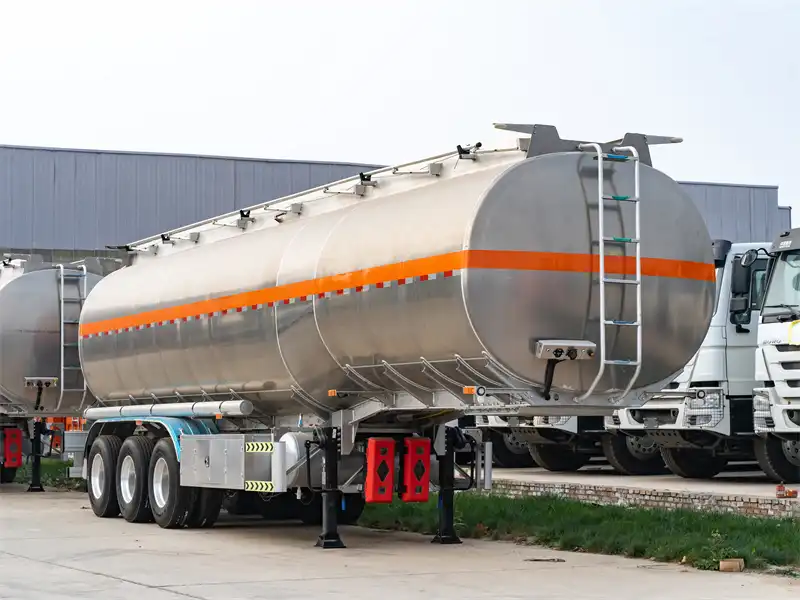
Fuel Tanker Trailer
How much fuel does a tanker trailer hold?
Most tank trailers have an average capacity of between 35 cbm and 50 cbm, which is equivalent to 35,000 liters – 50,000 liters. (9,246- 13,209 US gallons)
The ultimate capacity of a oil tanker trailer depends greatly on the design and construction of each trailer.
The key factors that determine how much fuel tanker trailer can hold are the materials used in its manufacture, its structural design, the thickness of the gas tanker trailer walls, the built-in compartments, and the strength of the tank trailer frame.
All of these factors have an impact on the final weight of the fuel tanker trailer, which in turn affects the size of the tanker trailer and the ability to transport fuel. The following are some of the factors that relate to the loading capacity of a tanker trailer.
I. Material
Tanker trailers are made of different materials, and the size and capacity of the tank varies. A lighter tank material can hold more fuel than a material with more mass.
The two common materials used to manufacture tanker trailers are aluminum and steel. The most significant difference in the characteristics of these two materials has to do with the weight factor.
Typically, steel is heavier than aluminum. Therefore the use of these different materials for the same size petroleum tanker trailer will result in a different weight capacity.
Below is a comparison between aluminum tanker trailers and carbon steel tanker trailers in terms of capacity.
– Aluminum
Tank trailer manufacturers are always looking for ways to improve fuel transportation efficiency. Creating more space to load fuel by reducing the weight of the semi-trailer is one way to do this. As a result, the use of lightweight materials can help develop more efficient petroleum tanker trailers.
Aluminum can do the job well. It has a lighter mass than other materials.
This means that aluminum tanker trailers can carry more fuel, with an upper limit of even 60,000 liters, making it a perfect way to reduce weight.

Aluminum Fuel Tanker Trailer
The downside is that aluminum is so expensive, resulting in higher costs, that many buyers will not consider aluminum fuel tanker trailers as their first choice.
Although the initial cost of an aluminum tanker trailer is higher, it will last longer than a carbon steel fuel tanker trailer. This is because aluminum tanker trailers do not corrode as easily as carbon steel oil tanker trailers, and aluminum tanker trailers are easy to maintain. This is another advantage on top of the increased fuel carrying capacity. So in the long run, aluminum tanker trailers seem to be a better fit.
– Carbon Steel
Carbon steel tanker trailers are comparable in size to aluminum tankers, but are heavier and therefore have less volume.
Carbon steel tanker trailers tend to add a lot of weight due to the greater density of carbon steel. However, compared to aluminum tanker trailers, carbon steel tanker trailers are more economical to purchase and have a stronger construction.
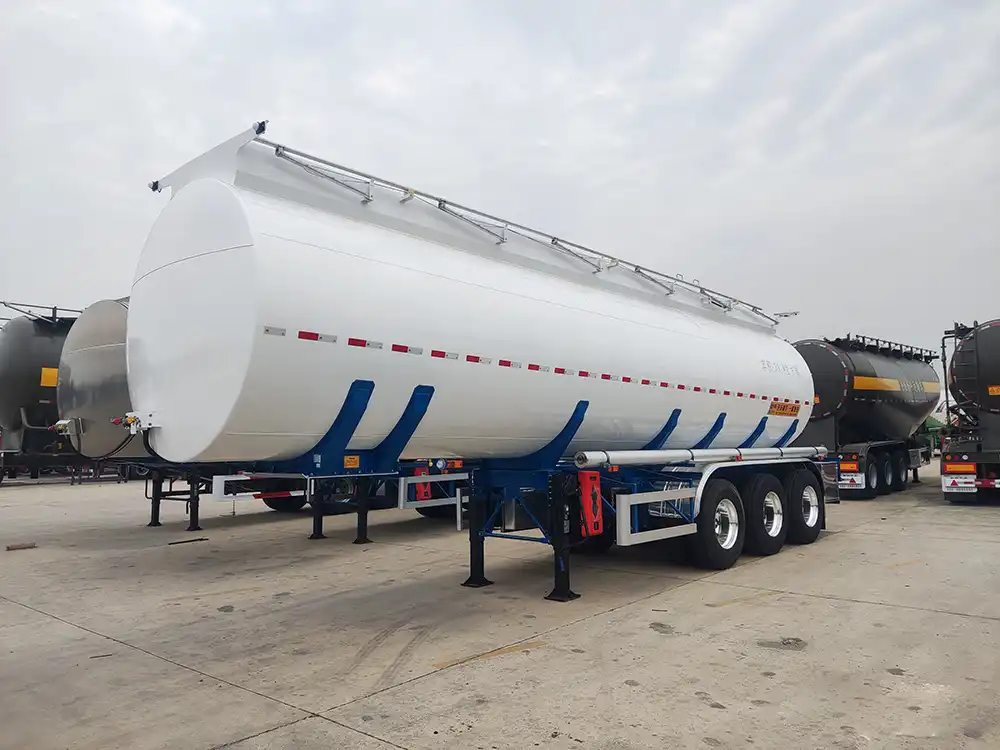
Carbon Steel Fuel Tanker Semi Trailer
The commonly used steel for carbon steel tanker trailers is 4-6mm Q235 steel.Q235 steel has greater toughness and higher elongation and is less prone to breakage.
Carbon steel tanker trailers are heavier when unloaded compared to aluminum tankers of the same size. As a result less fuel is carried and the truck will consume more fuel than an aluminum oil tank trailer.
Carbon Steel and Aluminum Tanker Trailers Options
Carbon steel tanker trailers usually have a greater weight capacity compared to aluminum tanker trailers. This is an important factor that you need to keep in mind when choosing a trailer.
If you have to choose this type of trailer, there should be a good reason to forgo fuel capacity efficiency. Again, carbon steel fuel tanker trailers are cheaper than aluminum fuel tanker trailers due to the manufacturing process and the price of the metal.
Steel is easier to fabricate than aluminum, especially when it comes to welding. However, aluminum is more resistant to corrosion than steel.
On the other hand, aluminum has a greater capacity due to its light weight. The main challenge with aluminum tanker trailers is the cost and manufacturing process, as aluminum is more expensive and more complicated to weld.
However, if you are considering how you can transport more fuel, then an aluminum tanker trailer will be the best choice for you. It will increase the cost-effectiveness of your operations.
Get a Quote on Tanker TrailersII. Structure
Different tank shapes have different upper limits. This determines how well the fuel is balanced within it to promote safe transportation of the fuel.
For example, a tanker trailer with oval construction has a lower center of gravity. As a result, it can be longer than round and square structures.
Enhanced stability means the ability to carry heavier loads and manage loading, transportation and unloading operations without fear of overturning and causing an accident.
Enhanced stability through structural design allows for faster delivery, as a more stable petroleum tanker trailer is faster than one that is not stable enough.
Ideally, tanker trailers come in different shapes such as round, oval and rectangular. The shape of the tanker trailer determines the stability and balance of the tanker during operation.
They have a height to gravity ratio of 1:0.79:0.65. large diesel tanker trailers imply a greater capacity to transport fuel. Therefore, for stability reasons, they are usually oval and rounded rectangular in shape. This shape of tank trailer has a low center of gravity and can remain stable.

Oval Fuel Tanker Trailer
Another factor to consider is the pressure at which the fuel will be loaded and transported.
If the type of fuel you are transporting requires high pressure tanks, make sure you choose a round tanker trailer. This will ensure that the pressure is evenly distributed and, most importantly, that they can withstand high pressures.
Get a Quote on Tanker TrailersIII. Tank Thickness
How much fuel do you wish to transport at one time? If it’s just a small amount, your oil tanker trailer may not need very thick tank walls. Keep in mind that this has nothing to do with the material you choose. It doesn’t matter if it’s a carbon steel tanker trailer or an aluminum tanker trailer.
When it comes to the amount of fuel to be transported, the thickness of the gas tanker trailer is the next factor to consider.
If you’re looking to transport a large amount of fuel, then keep this in mind: larger capacity tanks require thicker slabs of material to withstand the pressure, and most importantly, to keep the tank safer.
More fuel creates more pressure, so you need to compensate for that with the right tanker trailer tank thickness. This is especially true in the event of an accident with a high-capacity fuel tank. You can rest assured that your fuel tanker trailer can withstand the resulting impact.
IV. Compartments and Baffles
The capacity of the gas tanker trailer determines the maximum number of compartments and the maximum capacity of each compartment.
The purpose of the baffle is to prevent violent shaking of the liquid during transportation.

How Multi-Compartments Work
Therefore, the size of the diesel tanker trailer definitely depends on the number of compartments.
Each compartment can be accessed through a manhole cover at the top to facilitate inspection and maintenance work. Tanks with large compartments (usually over 2.5 meters) should be fitted with baffles.

Fuel Tanker Trailer Baffles
The distance between baffles should not exceed 2.5 meters.
If the length of the tank is large and more than one baffle needs to be fitted to meet this spacing requirement, the effective surface area of each baffle should be at least 70% of the maximum area of the tank cross-section.
This means that the final capacity of the tank will determine what additional components need to be added. Therefore, when choosing a tanker trailer, it is important to know how much fuel you want to transport.
As highlighted here, there are many aspects to consider.
V. Main Beam
Greater fuel capacity means more weight. As a result, gas tanker trailers need stronger main frames to withstand the greater capacity. The following are important requirements for this type of application:
- The main frame should be tightly bonded to the tank. This tight joint ensures even balance and stability throughout the tanker trailer structure. In this case, the center of gravity will be as low as possible, thus ensuring safe operation.
- High strength materials should be used. Sufficient strength is needed to withstand the weight of high-capacity fuel. Check with the trailer manufacturer to determine if the frame is structurally adequate to support it.
- The frame requires a sturdy design and high quality welds. High quality welding is important to ensure good strength of the frame. Perform standard welding inspection procedures under the guidance of an expert to ensure that your fuel tanker trailer frame is well built.

Oil Tanker Trailer Main Beam
VI. Fuel Density
In addition, the density of the fuel has an effect on the transportation capacity of the oil tanker trailer. The denser the fuel, the heavier it is for the same volume. If a tanker trailer does not have a high weight capacity, it will not be able to transport the fuel with a full tank.
For example, the density of gasoline is 710 – 770 kg/m³, the total weight of filling a diesel tanker trailer with 45,000 liters is: 37.8 tons of weight of fuel + 6.5 tons of weight of aluminum tanker trailer = 44.3 tons.
If your tanker doesn’t reach a weigh-in weight of at least 44.3 tons, it won’t be able to fill a 45,000 liter fuel tanker trailer.
How do I calculate fuel weight or volume?
You can use the fuel calculator below to calculate the weight and volume of diesel and gasoline.
Summarize
There are many aspects to consider in successfully selecting the right tanker trailer based on the amount of fuel you want to transport. Your choice of ideal capacity will be influenced by the following factors:
The material of construction of the tanker trailer, the design of the structure, the thickness requirements for different capacities, the number of compartments required, the quality of the structural frame, and the density of the fuel.
Steel and aluminum have been widely used in the construction of tanker trailers, but both materials have their advantages, with aluminum having a higher capacity due to its light weight.
Your capacity requirements will determine which tanker trailer you ultimately choose. Whether or not you choose a steel or aluminum tanker trailer depends entirely on all of the factors outlined here, i.e. the capacity requirements of all tanker trailers.

