







Knowledge Base
The Difference between Removable Gooseneck Trailer and Folding Gooseneck Trailer
Maybe before exploring the difference between a removable gooseneck (RGN) and a folding gooseneck trailer, it’s vital to understand what each type entails.
Gooseneck lowbed trailers, in general, connect via a ball hitch in the bed of a tractor, providing more stability than conventional trailers. These trailers come in different configurations, available in both hydraulic and mechanical versions.
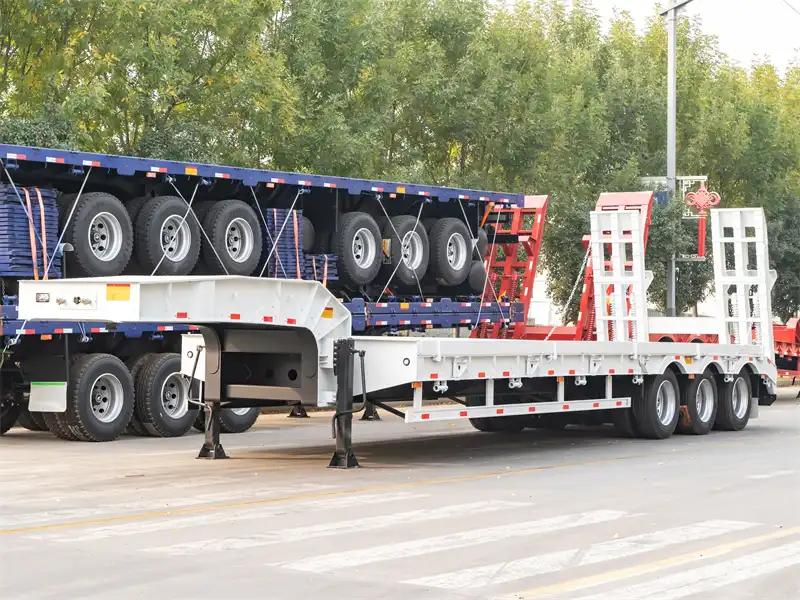
Among them are removable gooseneck trailers and folding gooseneck trailers. The removable gooseneck model features a detachable front that can drop onto the ground, forming its own loading ramp.

Removable Gooseneck Trailer
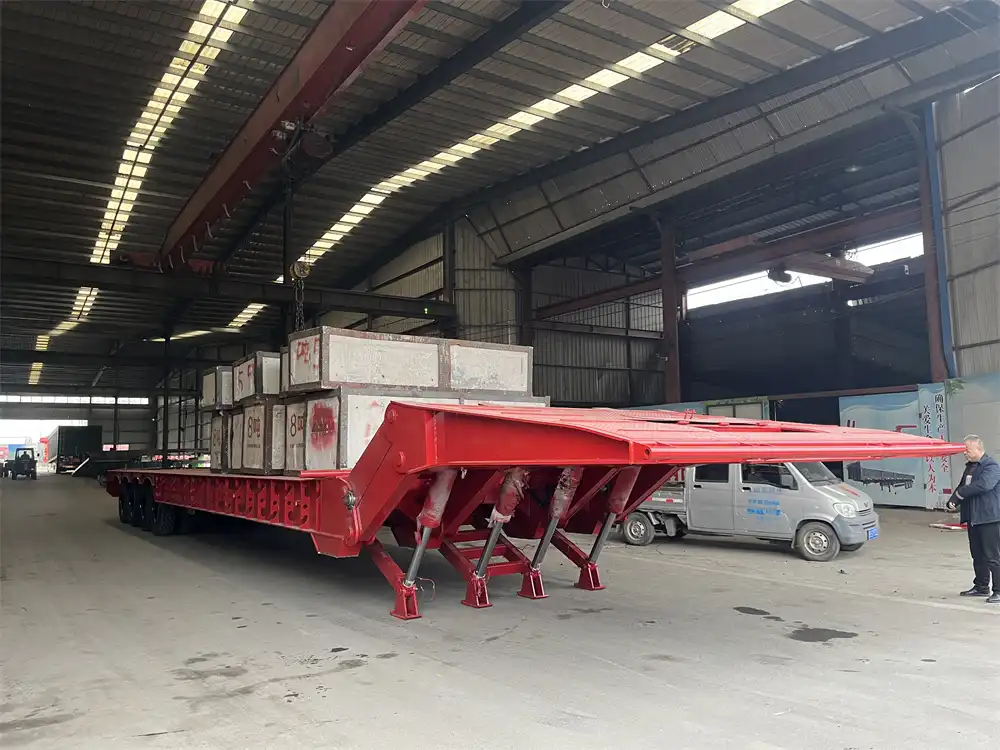
Folding Gooseneck Trailer
In contrast, a folding gooseneck trailer has collapsible goosenecks that simplify loading and offloading, even on rugged terrain.
The main distinction lies in the structure of their goosenecks. One crucial point to note is that both removable and folding gooseneck trailers can have various mechanical or hydraulic designs. However, this post primarily covers hydraulic versions because most mechanical structures are now obsolete.
Despite the many varieties of removable and folding gooseneck builds, their underlying principles remain similar. In this post, you will learn about the following:
- Removable gooseneck trailer’s structure and principle
- Folding gooseneck trailer’s structure and principle
- How to choose between these two kinds of trailers
For more details on low bed/lowboy trailers, check out: Low Bed Trailer Ultimate Guide – What is a Lowboy/Lowbed Trailer?
Table of Contents
-
What is the Removable Gooseneck Trailer
1 Why the Removable Gooseneck Trailer?
1.2 Operation Principle -
What is the Folding Gooseneck Trailer
1 Why the Folding Gooseneck Trailer?
2.2 Operation Principle
2.3 Possible Modifications - The Removable Gooseneck Trailer Vs. The Folding Gooseneck Trailer
- Conclusion
1. What is the Removable Gooseneck Trailer

Figure 1 Removable Gooseneck Trailer Structure
A removable gooseneck trailer is a hinged frame assembly typically used for linking a low-bed trailer to a tractor. It has seen widespread acceptance in transporting heavy equipment such as cranes, power shovels, and tractors.
This trailer type is normally attached to the tractor via a detachable gooseneck at the trailer’s front. Detachment occurs after lowering the trailer’s front end to the ground, allowing direct front-loading or offloading of heavy equipment onto or from the flat deck.
Get Detailed Specifications!
Contact us1.1 Why the Removable Gooseneck Trailer?
The Removable Gooseneck trailer simplifies commercial operations by saving space and utilizing lighter units through a hinged frame assembly. Previous gooseneck designs had a complex connecting structure, so the new design improved:
- Reduced weight thanks to a simpler frame assembly
- Easier detachment for front-loading heavy machinery
- More compact construction than older assemblies
In short, the Removable Gooseneck trailer offers both a straightforward build and reduced complexity, making it lighter and more compact than many other low-bed trailer connections.
1.2 Operation Principle
This design features a hinged frame assembly (see Figure 1) that connects to a pivotable tractor fifth wheel on one end, and a base member on the other. By activating an actuator between the base member and the draft member, you raise or lower the front end of a low-bed trailer attached below. This action enables smooth front-end loading or unloading of heavy equipment.
Get Detailed Specifications!
Contact us2. What is the Folding Gooseneck Trailer
Conventional heavy-duty industrial trailers often feature a low bed with multiple rear wheels and a fixed gooseneck at the front, which engages the tractor’s fifth wheel.

Figure 2 The Folding Gooseneck Structure
A folding gooseneck trailer, however, applies collapsible goosenecks for efficient loading and offloading. While there are both hydraulic and mechanical types, mechanical versions—using cables and winches—are mostly outdated due to their slow operation.
The hydraulic folding gooseneck trailer typically includes a retractable pedestal that keeps the platform level with the ground as the gooseneck folds into an inclined ramp. Care is necessary when loading on an incline or uneven surface. Locking pins must keep the gooseneck upright during towing.

Folding Gooseneck Trailer
2.1 Why the Folding Gooseneck Trailer?
The folding gooseneck trailer addresses the need for a bed that can lower and rest flat on the ground. Multiple ground engaging pads, each independently adjustable, handle loading operations even on uneven terrains. Additional benefits include:
- Independent ground adjustment for irregular surfaces
- Hydraulic operation separate from the bed-support structure
- No need for locking pins to keep the trailer upright during certain procedures
2.2 Operation Principle
Upon arrival at the loading site, the trailer’s driver typically engages the power pack (55 in Figure 3) and lowers the ground engaging pads (19) via the lever (48 in bed-up position). After the trailer is self-supported, the tractor can disengage and drive away.
Next, moving lever 48 to the bed-down position lowers the trailer bed to the ground, with the gooseneck still upright. Switching to float position brings the gooseneck down, forming a smooth ramp. Once loading or offloading is complete, the reverse sequence raises the trailer, reattaching it to the tractor.

Figure 3 The Folding Gooseneck Operations Diagram
2.3 Possible Modifications
Although the details above represent a typical folding gooseneck setup, various modifications can be made without altering the foundational principle. For instance, choosing a commercial trailer with:
- An extended load-carrying bed
- Ground engaging wheels on one end
- A selectively foldable gooseneck with a hitch platform
- Independent or separate fluid systems for lowering the bed and operating the gooseneck
These enhancements remain within the original design’s scope, allowing for broader customization.
Get Detailed Specifications!
Contact us3. The Removable Gooseneck Trailer Vs. The Folding Gooseneck Trailer
Selecting the right trailer depends on many factors, such as cost, durability, functionality, and capacity. Both removable and folding gooseneck trailers can haul heavy machinery, but how do you determine which suits your needs?
The primary goal is to ensure that goods arrive securely, minimizing downtime and potential losses. Below are key aspects to consider:
- Efficiency
The folding gooseneck trailer stands out in efficiency because its ground engaging pads adjust independently, simplifying loading and unloading on uneven terrain. This gives it a flexibility advantage over the removable gooseneck trailer. - Customization
For those needing a trailer adaptable to various applications, the folding gooseneck trailer is more customizable. You can manipulate its design to handle different tasks—something less feasible with a removable gooseneck trailer. - Cost
The removable gooseneck trailer generally costs less than the folding gooseneck. The folding gooseneck’s advanced systems and features drive up its price, though they also enhance stability and utility. - Durability
The removable gooseneck trailer is rugged and can endure extensive use without frequent maintenance. The folding gooseneck’s many hydraulic components often need more upkeep due to added complexity. - Operation
Operating a removable gooseneck trailer on rough terrain can be more challenging. In contrast, the folding gooseneck offers simpler adjustments thanks to independently controlled pads, making it easier for complex terrains. - Technology
The removable gooseneck trailer design is relatively straightforward and lightweight. The folding gooseneck, with multiple integrated systems, is more technologically advanced and may require specialized knowledge to operate.

Detachable Gooseneck Trailer
Get Detailed Specifications!
Contact usConclusion
Both removable gooseneck trailers and folding gooseneck trailers deliver unique features and benefits, and your final decision should align with the demands of your specific operations.
- If you need something straightforward for simpler applications, a removable gooseneck trailer could be perfect.
- If you require enhanced maneuverability, on-the-fly adjustments, and the ability to handle uneven terrains comfortably, a folding gooseneck trailer will serve you better—albeit at a higher cost.
Ultimately, weigh factors such as budget, performance, and maintenance requirements before making your choice. With a folding gooseneck trailer, you gain versatility in nearly any loading environment, while a removable gooseneck trailer remains an economical, sturdy solution for conventional tasks.
Need more details or professional advice on your best trailer option?
Feel free to contact us for additional guidance.

